Showing posts with label war. Show all posts

Thursday, November 11, 2010

The War on Terror is Really About Cults

The "War on Terror" is not going as well as it could, and we really need to rethink our basic assumptions about it. By basic assumptions, I mean we need to question what is the essence of terrorism, and if we know what it is, then can we come up with an effective method to fight it?

We could think of terrorism as a criminal activity, or a cult activity, or we could think of it as a clash of civilizations. Each one would require a slightly different approach, and maybe terrorism is a broad enough concept to have elements of all three. But the approach we seem to have committed to most strongly is treating it as a clash of civilizations. Therefore we are fighting two wars using modern military technology against guerrillas (terrorists, freedom fighters, militant Islamists). This technique seems to be a self reinforcing diagnosis, and the more we treat it as a war, the more it becomes a war. And as I said, this is not working too well.

We could treat terrorism as a crime, but we do not seem to have the international system of justice and enforcement to bring it totally under control. So that seems unsatisfactory also.

We rarely try to treat it as a cult activity. A cult is a group that makes members psychologically dependent on it, and controls their behaviour this way. I suspect that a large part of terrorism has cultish aspects. Although we often blame the Islamic religion, the truth is that these are cults within Islam. A cult does not have any true religion. A cult adopts whatever religion is handy. We have many thousands of cults or near-cults in North America, and many of them use the name of Jesus. Back in the sixties, it seemed cults had a lot of success with eastern religions, and so many of them went with Hare Krishna or some other faddish religion. In the middle East, these cults go with Allah, because the usual way for cults to work is to start off with a popular local religion and simply use the local God as one tool in their bag of mind control tricks.

The reason we don't want to face the reality of cults is that so many North Americans are in cults, and they do not want the light of reason to be shone too brightly on their activities. Many of these cults are benign, and don't disobey the law in any way, although some are violent and perform terrorist acts. But even law abiding cults still cause grief to families who lose members to them. Deprogramming is an effective technique to use against cults, and many cults have been weakened, as their followers have been rescued through these techniques.

Take for example Omar Khadr, a story that has elements of all three. He was rounded up using a war, with bombers, and soldiers killing most of his cult-like party. He was tortured during interrogation, and I don't even know whether that activity falls under war, justice, or some sort of medieval throw back to the dark ages or the inquisition. Then he was put on a show trial, with some elements of a legal system, however flawed that might be. As a result, he will spend the next year in solitary confinement, after which he may be eligible for release in Canada. All of these things are unsatisfactory to some degree.

If we had recognized the cultish aspect of terrorism, we could have used deprogramming from the start. Instead we seem to be increasingly blaming the Islamic religion.

Many cult like churches in the USA, have an agenda that includes a broad based struggle against deprogramming, so this was never tried in our "War on Terror". The cultish Christians also have a belief in the end of the world, and the superiority of Jesus over Allah, and as a result find a holy war not only acceptable, but pre-ordained by God. Of course they are going to suppress any talk of terrorism being nothing more than another form of cult activity, which happens to borrow its rhetoric from the Koran instead of the Christian Bible. (And in case you are wondering, the Bible has plenty of quotes to support any kind of evil activity if you twist the words enough) For example, Elizabeth Smart's kidnappers were Jesus based cultists who used the bible to justify kidnapping and rape.

Americans do not really need the cults to fight a war on terror, as they have the military. But some people in the middle East have discovered the use of cults as a serious weapon in their fight against the USA or even the USSR.


Deprogramming works: http://www.cultnews.com/?p=1814

Top Ten Cults: http://listverse.com/2007/09/15/top-10-cults/

Picture: Cultish practices, http://www.squidoo.com/wordoffaith

Sunday, November 7, 2010

Words About Child Soldiers from Col. George Carsted

The Calgary Herald often proudly carried conservative points of view, and that is where I found this anti-Omar Khadr rant by Col. George Carsted.

He recounts how he was only 14 when he took up a gun against the Red Army as it approached his town. But although his action was similar to Omar Khadr, he feels no sympathy for him.

Here are some of his arguments, starting with the point that since he did not see himself as a child at 14, then neither was Omar Khadr a child at 14.

He says:

"I did not see myself as a "child." I may have been scared, but I knew what I was doing."

"He [Omar] did not fight for his country, but supported the aims of a fanatical segment of Islam, whose actions are abhorred by all having one ounce of decency -- regardless of religious affiliation"

"I deem it time for the introduction of a law that strips anyone, whether born in Canada or being a naturalized citizen, who commits an act of terrorism or takes up arms against Canadian troops or those of her allies, of that citizenship"


I would not call George a child "soldier" at 14, from the description he was not part of any military training, nor was he in an organized group. He was just a kid with a gun.

He says Al Quaeda is "abhorred by all having one ounce of decency", when the well known fact is that Al Quaeda was financed and armed by the US government to fight the Red Army in the nineteen eighties. Ironically, the same army he fought when he was 14.

But please, let's not introduce a law that blindly strips anyone of Canadian citizenship for taking up arms against Canadian Troops or those of her allies, because Col. George Carstead would be among those to lose his Canadian citizenship. He has publicly confessed (in writing this article) to taking up arms against the Red Army, which were our allies at that time, against the Nazis in WW2. Maybe if George had been a bit older, he would have known that to fight the Soviets in WW2 was to help the Nazis. But he was just a kid, and probably didn't know what he was doing, no matter what he thinks now.

It's not as easy as you think to write laws condemning someone for the very same thing you do yourself. Double standards are difficult to uphold in the Canadian legal system, and I like it that way.

Picture: Some more teenage soldiers, from the movie "Red Dawn", fighting the Red Army.

Saturday, November 6, 2010

About Supporting the Troops, Canadian Style

I just read a headline in today's newspaper "Taliban Smell Victory". I think they could smell victory quite a while ago, or they would not have been able to recruit so many people to run around blowing themselves up and planting land mines.

The point where I realized that the war in Afghanistan was going nowhere was at a CIGI talk given by the Canadian Brigadier General Denis Thompson, April 15, 2008 in Waterloo. He gave a presentation of all the methods Canadian forces were going to employ to pacify Afghanistan. Afterwards was a question and answer, where one person asked "Since the Soviet Union lost in Afghanistan, what makes you think Canada can win?"

The Brigadier General answered "Because we were invited there." I knew right away he had made a slip up, because the Russians had been invited too. However, the Q&A was not a debating forum, you simply asked your question and the speaker replied and then on to the next questioner.

http://www.cigionline.org/events/archive/35?page=4

I'm sure if any Taliban were sitting in the room at CIGI with us, they could have smelled victory right there, too.

I do not particularly like being accused of "Not supporting the troops" when I say we are not going to win this one. In order to win, you need to know what you're up against. We lost it a long ago when we allowed the Christian Fundamentalists to make this into a Holy War against Islam. We lost it when we admitted that we could not stop the torturing of detainees. We lost it when we started thinking that we were going to advance the cause of women's liberation in Afghanistan. We lost it when the U.S. decided to pull out and go fight Saddam for the oil, instead of hunting Bin Laden. The fighting itself is now just window dressing. You can't win a war if you can't think, and we cannot think while we have our heads full of ridiculous propaganda.

But when it comes to supporting the troops, I am right there. Recently, a friend of mine died, and I went to a reception after the funeral. The reception was held at the local Royal Canadian Legion. I had no sooner walked in than somebody hissed at me that I was dishonouring the dead and I needed to remove my hat. Apparently the dead he was referring to were the war dead. Later I found out that every branch of the Legion has the same inflexible rule. Hats off to honour the dead. No headgear of any kind. I took my hat off. I want to support the troops after all.

But last week, there was a Halloween party at the Royal Canadian Legion in Campbellford, and somebody dishonoured the dead by wearing a hat. Did somebody tell him to remove it? NO. He was given a prize for his costume. Was there any talk of dishonouring the dead? Apparently not. It sounds like a double standard to me. I cannot wear a baseball cap that says "Canada" on it, but this guy can wear a Ku Klux Klan hood, and carry a noose draped around the neck of a pretend black guy, and wins a prize.

Not one article or comment I have seen about this has anything to say about the "no hats rule". I don't want to get into a ridiculous argument of whether or not this was bad taste. But apparently I'm the only one who remembered that wearing any hat at the Legion hall dishonours the dead, let alone a KKK hood. Next time, you sanctimonious hat haters, how about reminding the racists to remove their hoods, too.

I just want to follow up with the comment that if people at the Legion, presumably with some military sensibilities, cannot figure out whether this KKK guy should be kicked out immediately, then we really have no chance winning a war in Afghanistan, because winning requires some cultural smarts as well as air strikes. If we are going to be idiots, we should stay home and be idiots.

Here are the links to the rule, that requires anyone entering a Canadian Legion (an Armed Forces veterans’ association) premises to remove their hat.

http://www.aroundtaber.com/Default.aspx?alias=www.aroundtaber.com/tleg
www.openschool.bc.ca/features/samples/law12_sample.pdf

And about Sikh Turbans in the Legion???
http://www.gearslutz.com/board/moan-zone/93334-hat-etiquette.html
http://www.williamgairdner.com/poppies-trump-turbans/

Considering all the controversy about wearing headgear of any kind, how come the KKK guy gets a free pass and a prize to dishonour our war dead?

Picture: Bikers supporting troops, from this website. http://westerncanada-un-nato-veterans.blogspot.com/2009_06_01_archive.html

Monday, November 1, 2010

The Omar Khadr Case: Is the War on Terror a Real War?

Although the Omar Khadr case is full of contradictions, it also holds the key to understanding the "War on Terrorism". You can read about it in this Australian news story, much easier to understand than any Canadian papers, as we Canadians are too involved with it.

This case sums up the contradictions in the war on terror. The essential ambiguity is that it is not a real war. In a real war, you have countries fighting each other with uniformed soldiers. Terrorism is stateless, there is no enemy country. The military is fighting underground organizations. There are some people who think that the fight against terror should be an international police effort, that terrorism should simply be considered a crime, and the perpetrators captured and put on trial in a normal court of law. But other people argue that it is more than criminal activity, and police action is not enough to stop it.

The Omar Khadr case exemplifies the confusion between war and police action. In a real war, it is not considered illegal to throw a grenade, or shoot a gun. In fact Americans do it all the time. But yes, in peacetime, it is actually illegal to throw a grenade at someone, even a soldier.

Yesterday, Omar Khadr was found guilty of throwing a grenade, and sentenced to 40 years behind bars. Does that make sense in the light of what actually happened? This is the situation. A fight took place between a handful of AL Quaida members and about 100 soldier, US and allies. The American assault included air strikes that basically killed every one of the Al Quaida people, except Omar Khadr. The assault was not illegal. But at some point, a grenade was thrown at an American, and this act was considered the criminal act.

Omar may in fact be the one who threw the grenade. There is no question that he was in the house during the slaughter. Omar was the sole survivor on the Al Quaida side, and badly injured during the fight. He was also 15 years old, and a Canadian citizen. But he was not a legitimate combatant, so it was illegal for him to throw grenades at American soldiers, or shoot them, or do anything against them.

The Americans wish that it was a real war, and they could drop all the pretense of "due process of law". It would be ideal for them if the enemy would form up in battalions with uniforms, tanks, generals, barracks and headquarters. They wish the enemy would name a country that they belong to. Then we could have a nice clean war like WW2, where it is obvious who would win. (assuming the enemy had no comparable air force of course, or atomic bombs). But the real weakness of the military is that they are always fighting the last "good" war, and have no understanding of the next one.

So what we have is a new kind of war. A war where the usual conventions of war don't apply, but the usual conventions of the peace time criminal justice system do not apply either.

We actually need some new rules that make sense. Right now, Americans are making up the rules as they go along, nobody else is being consulted. And maybe they are right. But what they decide is what military combat will probably look like for many years to come.

There will be no rules to protect the enemy. Once a certain group is declared to be terrorists, then it will be legal to bomb villages where they are thought to be hiding. It will be legal to kill civilians who may or may not be the enemy. It will be illegal for anyone to shoot back, to possess arms which may injure the legitimate army (whatever country that may be, USA, or China or Russia for example). It will be legal for a country with a strong military to invade another country to root out the terrorists, and the invaded country will not need to be a real threat, or even be belligerent. It will be legal for the military to detain anyone for any reason, and it will be legal to torture detainees into naming collaborators or confessing to crimes. It will be legal to assassinate (for example by missile strike) foreign leaders who are thought to be cooperating with terrorists. It will be legal to hold trials for terror suspects, without giving them any of the traditional benefits of the legal system. It will not be necessary to honour the Geneva conventions of war unless the terrorists are uniformed soldiers, under orders, defending themselves against an attack. People of a certain religion will become legitimate targets, wherever they live, similar to the old concept of "holy war".

Although none of these characteristics are being written down in a new code of conduct yet, the rest of the world is watching, and getting the message.

Maybe we should learn the lesson of history. The world was horrified that the Nazis starved and killed millions of innocent people in concentration camps. But who invented the concept of concentration camps? I believe it was the British, during the Boer war in about 1900. They rounded up all the Boer women and children, forced them into camps, where tens of thousands of them died of starvation and disease. The lesson is, if you do something bad, sometimes other people will adopt your ways. On the other hand, Jesus said "do unto others as you would have them do unto you." And I believe it's still a good rule today. It's just sad that a country calling itself "Christian" seems to not get it.

Picture: I am not sure what this picture means, but I got it from the website calling itself "Satan's Rapture.com: Point of no return", and their message seems to be that the Muslims are taking over the world and all the women will have to wear a burkah. (Just my own comment here: I lived in a Muslim country for three years and never saw one burkah. So maybe the Muslims should be talking to their own women first before they try to spread that style of clothing around to blue eyed blond women, who are probably Christian or maybe atheists at worst.)

http://www.satansrapture.com/islam.htm

Thursday, September 23, 2010

The Fall of France, 1940, Explained

Marc Bloch, a French officer in WW2, wrote a book about the defeat of France. This book, titled "Strange Defeat" survived the war, although the officer did not. After the French surrender, he joined the resistance and was captured and killed by the Nazis a few weeks before France was liberated.

The Wikipedia entry for Marc Bloch has a link to a small Wikipedia article on the book "Strange Defeat". I found a much bigger entry for "Strange Defeat" on Wikipedia in French. I wrote a translation, which I have included below. (Disclaimer: Although I understand French well enough, I am not a translator, and for me this entry was a bit difficult to follow.)

A translation from Wikipedia "Etrange Defaite" or "Strange Defeat"


The analysis of the French Army by Marc Bloch starts at the bottom and goes to the top levels.

A Sclerotic Army

He denounces first the bureaucratic character of the army, attributing it to peacetime habits: in particular the "cult of beautiful stationery" [maybe "Desk Jockeys"?], and also the "fear of displeasing one with power, today or tomorrow.". These habits led to a dilution of responsibility between too great a number of hierarchies, as well as a delay in transmitting orders. He sees as a prime cause the the advanced age of the French Army's staff, little renewed, as opposed to a much younger German army.

This bureaucratic organization is also founded, according to him, in the training of the officers, which revolved around a cult of theory and tradition. The main source of this education is the "Ecole de Guerre", where Marc Bloch had refused enroll, which he pays for in not being allowed to be promoted past the rank of captain. Based on the experience of the First World War, the teaching of this school, in fact, advocated the superiority of infantry and artillery, as opposed to mechanized units (tanks and aircraft, among others), supposedly "too heavy to move". Similarly, education policy is based on theoretical rules of engagement, elegant and abstract, which do not pass the test of practice. This teaching is associated with a culture of secrecy, which slows the transmission of information, and a cult of command, in reaction to the questioning of authority that took place in 1916 and 1917.

The association between the bureaucracy and rigid training leads, on the field, to general disorder, with three captains who succeeded to his post in a few months, and especially serious shortcomings in the management of men and equipment. The soldiers are poorly housed and physically relocated regardless of their ability to move, wasting energy in marching forward and back again. Similarly, materials are in short supply, facing a well-equipped German army. The French army lacks in quantity, military budgets have been sunk in to the fortification of the east border (Maginot Line, among others), leaving open the north. It also lacks concentration, the tanks are scattered in many corps, which makes any concerted movement impossible. Soon this mess on the ground was found at all levels, with rotations too rapid for staff to have time to learn their duties, and a carelessness in upkeep of the premises and records, that in a bureaucratic context, completes the paralysis of the French army.

The incapacity of intelligence services [edit]

The army becomes exhausted, most often, not knowing where the enemy is, and Marc Bloch blamed the intelligence services. It is above all, he believes, due to poor organization. As a captain in charge of gasoline (supply of fuel and ammunition to troops), he will only receive low-level information bulletins, as important information was classified secret and communicated too high in the hierarchy. All information passes through excessively long reporting lines, and ends up being out of date by the time it comes to people who need it.

It becomes impossible to know how soon an order can be executed, which leads to other unforeseen delays in maneuvers, such as retirement of the armies of the Meuse and Sedan, which exposes the rear of the troops in Belgium. Faced with this situation, each corps and almost every officer, including himself, sets up its own intelligence operation, leading to a disastrous competition in services and the insufficient contact between the various levels of command, to the point that the officers often do not know where their own troops are.

The intelligence services have also seriously underestimated the scale and mobility of the German army, causing them each day to send the troops too late to the German advance. It highlights in particular a chronic inability to properly estimate the speed of movement and the number of German tanks and aircraft, by the French armed forces who are still obsessed by infantry and artillery. This inefficiency of information leads to great surprise in the French high command.

This concentration of information, on what was not the spearhead of the German Army, is the sign of a rigid and outdated strategic thinking from the French command. Rather than respond to the errors in estimation, the senior officers are continually surprised that "the Germans simply had advanced more quickly than what appeared to conform to the rule", the rule in question is based on the study Napoleonic campaigns and the previous war. Similarly, officers are often locked into basic plan that they knew to be obsolete, not having been trained to adapt to new situations. "In a word, because our leaders, amid many contradictions, argued, above all, to redo the war of 1915-1918. The Germans were doing the war of 1940."

This neglect naturally had a serious impact on the morale of the troops, beaten down both by a feeling of helplessness and fear, the enemy was never where they were expected by the army command. A man can better endure an expected danger, than the sudden threat of death at a bend in a supposedly secure road.

Command responsibility

"We have just suffered a tremendous defeat. Whose fault was it? The parliamentary system, the troops, the English, the fifth column", say our generals. Everyone, in short, but them. "

Marc Bloch's indictment against the French General Staff was particularly heavy. He first noted a crisis of authority. The big chiefs were reluctant to change collaborators, resulting in a "divorce" between command and those who carry out the orders. He noted especially the inconsistencies within the command, where leaders have a near-total impunity despite major deficiencies, while subordinates are harshly punished for little mistakes. This impunity leads to less accountable leaders who are able to dodge the necessary solutions, as long as they to buy into the thought patterns of the War College. Promotions based on age over competence, which makes it even more difficult because of the [high?] average age of officers. Coordination of command also disappears in turf wars between chiefs, and rivalries between multiple offices and between various army corps.

The Allies

Because of his position, Marc Bloch is often in communication with allied forces, and he draws a gloomy assessment. He first pointed out the difficulties with the soldiers and people.

Although professional soldiers, the British apparently have a disastrous "rape and pillage" behaviour. This reinforces among the peasant population, whom they despise, a latent historical Anglophobia. This feeling is again reinforced when one realizes that the British have turned tail and are fleeing first, and are jockeying to be evacuated, blowing up bridges to cover their retreat without worrying about the French troops remaining behind. "The British refused, naturally enough, to commit themselves to a disaster for which they felt they were not responsible." The British, meanwhile, judge the inadequacies of the French army harshly ("our prestige had outlived itself and they did not try to hide it from us"), and the French command in turn resorts to Anglophobe propaganda to hide its own failures.

On several occasions, as with the breakthrough to Arras, the British did not provide promised aid, seeing the faults of the French strategic plan. These failures led to an abandonment of collaboration between the staffs, a failure of the alliance. The armies were no longer coordinated by common authority following the encirclement of the GHQ (General Headquarters). Without effective linkages, or camaraderie, the French army remains ignorant of the weaknesses of the British army. In the United Kingdom, subsequently, the population welcomed the French, but for the authorities, a "a stiff bit of suspicion" remained.

Examination of Conscience by a Frenchman

Bloch does not attribute responsibility for the defeat solely to the army. He connects the shortcomings of the former with the unpreparedness and the myopia of the French people as a whole.

The State and the parties [edit]

His first target is the State and parties. He denounced "the absurdity of our propaganda, its irritating and rude optimism, his timidity, and above all, the impotence of our government to honestly define its war aims." The inertia and the softness of the ministers are stigmatized, and the abandonment of their responsibilities to technicians, recruited on the same corporate basis (Ecole Polytechnique and Sciences-Po, above). All these petty functionaries are advancing in seniority in a shared culture of contempt for the people, of whom they underestimate the resources.

Political parties are also stigmatized in their contradictions. Thus, the right-wing parties, who forget their Germanophobia, bow to defeat and to pose as defenders of democracy and tradition. Similarly, the left votes down the military budget and preaches pacifism, but calls for guns to Spain. Bloch accuses the unions of philistinism, obsessed by their own immediate interests to the detriment of their future or the interest of the country as a whole. Similarly, he condemned pacifism and internationalism as incompatible with the worship of the country, criticizing in particular their pacifist preaching that war is a matter of rich and powerful that the poor have no power to interfere (a Marxist interpretation of the conflict)

Workers and citizens [edit]

In the population as a whole, he denounces back to back, workers and bourgeois. He accused the former of seeking "to provide the least possible effort, in as short a time as possible for as much money as possible" in disregard of national interests, resulting in delays in war production.

Conversely, he accuses the bourgeoisie of selfishness, and blames them for not having informed the man of the streets and fields on the challenges of the country or even in providing a basic education (reading problem). It depicts a bourgeoisie living off investments, studying only for for their own pleasure and thinking only of having fun. He thus describes "the great misunderstanding of the French, who are facing a bourgeoisie whose investment income declines, threatened by the new social strata, forced to pay for themselves and finding that workers work less and less, and people are poorly educated, unable to understand the gravity of the situation. It highlights in particular the sharpness of a bourgeoisie which has never recovered from the Popular Front. Away from people, the bourgeois "unintentionally deviate from France as well."

In the more immediate level, Marc Bloch describes a people poorly prepared. Propaganda maintains a sense of security, although we have known since Guernica there is no more "sky without threat". Despite the image of Spain in ruins, "we had not said enough to make us afraid, and not enough so we would accept the inevitable new or renewed war."

The class of 1940 had hardly been prepared, and as we did not want war, we went with no zeal, with resignation. Bloch suggests instead that, faced with national peril, no one should have immunity, even women can fight the war. But the politics were to avoid the death and destruction of the previous war: "We thought it wiser to submit to anything rather than accept, again, this type of loss." In this context, the outflow is from a common cowardice, especially the lack of effort by the people to understand, who prefer to return to the rural life and refuse modernity.

Conclusion

Marc Bloch notes therefore a shared responsibility, which leads to a surrender, too quickly, of a war that may have been continued. Few people are blind, but one dares not speak up and denounce the deficiencies before they are revealed by the conflict and, therefore, no one dares to question conventional wisdom.


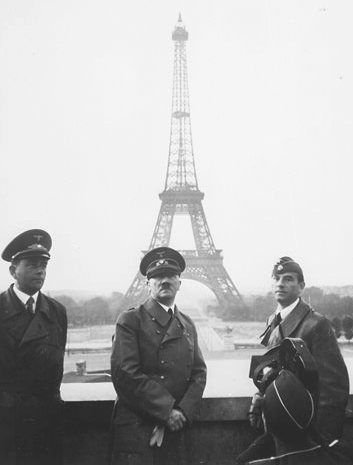
Picture: Hitler in Paris 1940.

Wednesday, September 15, 2010

A List of French Military Victories

It seems that in the last few years, many Americans cannot get enough of this joke: "List all the French military victories? Answer: There are None!" (or some variation of that.) This seems to have gotten started when the French refused to join Bush's war against Iraq.

It goes to show what a lack formal education in world history at the high school level can do to an entire country. Even university level world history in America is very one sided, if their view of Canadian history is any example.

Anyone with some understanding of Canadian history will know that this very topic comes up a lot in wartime in Canada, because our country is officially both French and English. Being an ex-history teacher, and half English and French myself, I feel that I can answer the question at least as well as most Americans.

List some of the more notable French Victories:

732 A.D.: Tours, the French hold off the Muslim invasion of Europe

If the French had not won that one, we all might be speaking Muslim today and this entire discussion would end here.

1066: French soldiers under William (the conqueror) invaded and conquered England. If Americans are not aware of this date, they should ask an English person for confirmation.

1427 Joan of Arc leads French armies in a series of military victories to save France.


1690 Battle of Quebec. This is the first major face off between the Americans and the French in the colonies. William Phips, Governor of the British Colony of Massachusetts, led an invasion against the Colony of New France (today Quebec). The French colonists won, despite the greater population of the American colonies.


1781 Two battles in one offensive: The Battle of Yorktown (American/French land siege) and the Battle of the Chesapeake (French naval victory) These two battles, one on land an one at sea set the stage for the British surrender in the American War of Independence, leading to the formation of the United States of America. Many Americans have decided that the French were of little or no help in these battles. Take a look at the casualties. Most were in the Battle of the Chesapeake, and I am guessing none of those were American.


France under Napoleon had a series of military victories in Europe. At the peak of their empire, they controlled more of Europe than Nazi Germany did in WW2, and similar to the Nazis, the French were defeated when they tried to conquer Russia in 1812. After the losses on the Russian front, a weakened French army was finally defeated.

French Victories during the Napoleonic wars:

1796 Battle of Lodi drove the Austrians from Italy

1805 Battle of Austerlitz, defeated a coalition of Russia and Austria

1806 Battle of Jena defeated Prussia (today Eastern Germany)

1809 Battle of Wagram French defeat Austrians


Now just for some balance, lets look at the historical French Defeats, as told by an American humour website.

Basically, as most of the arguments go, any French victory was either led by a foreigner, or a woman, or was too long ago, or they won a battle but lost the war, or had help from somebody else, and therefore doesn't count. Therefore, the French are cowards. Just a reminder, it is battles, not wars that are usually won or lost on bravery or fighting skill. The winning of wars also depends on depth of resources and strength of the economy, and geographic issues.

One of the most famous French defeats was the Battle of Waterloo in 1815. The U.K. and their allies (most of what is Germany today) vs. France.

Even worse was France defeated by Nazi Germany in 1940. At the end of this battle, France was fighting alone against Nazi Germany. Their allies Belgium and Holland had surrendered. The Soviet Union had signed a peace deal with Hitler. The British had evacuated their troops back to England. America was neutral, or helping any side that could pay for it. Italy joined in on the side of the Germans following the British withdrawal. At the end of the war, Americans found out that it was tougher than they thought to beat the Germans. Most of the heavy work was actually done by the Soviet Union in forcing Germany to surrender.

By comparison to the defeat of France, the Russians did not surrender when the German Army invaded. However, in stopping the Germans, they had 800,000 soldiers killed and 3,000,000 injured. The Russians also had the advantage of a large territory to retreat into, and a long hard winter to slow down the Nazis.

A major recent French defeat was in Vietnam. The French asked the US for assistance, but instead the US decided they could do better and went at it alone after the French withdrew. Most people agree today that the US did not do any better than France in the Vietnam war.

Here, from an American writing on a Chinese website (I'm guessing, see for yourself on the link), is a quote
"But there are two things I hate more than I hate the French: ignorant fake war buffs and people who are ungrateful. And when an American mouths off about French military history, he's not just being ignorant, he's being ungrateful."


http://www.napolun.com/mirror/napoleonistyka.atspace.com/bayonet_battles.htm#hatefrance


Further reading: French Army 1600-1900

http://www.napolun.com/mirror/napoleonistyka.atspace.com/FRENCH_ARMY.htm

Sunday, September 5, 2010

Jesus is In It to Win It

Before I begin, I am not a believer in the pro-war Jesus.  So read this in light of the fact that I do not think it is right for pro-war Christians to boast of their peacefulness, while ignoring Jesus's messages to love those that hate them.

Pro-war Christians argue that Jesus came as a strong warlike God, not as a wimpy pacifist. You can take a look at the web page I linked to here, to see many arguments for a warlike Jesus, and to re-interpret everything Jesus said in light of right wing pro-war conservatism.

Now, the rest of this blog is what I might think if I was hypocritical enough to believed in a pro-war Jesus.

>I kind of like the idea of Jesus as a winner, leading his troops to victory over the heathens, and not a pathetic loser pacifist. Once all the liberal crapola is removed from the Gospel of Jesus, I finally do get His message,

The Short Version of the Gospel According to Pro-War Jesus

Once upon a time, God looked down from the heavens, and decided that His people of Earth were not powerful enough or rich enough, so he sent his only begotten son to restore their God given lifestyle. Jesus came to Earth, with the good news "Get yourself a sword" (or a gun, in case they have been invented by the time you read this).

Jesus taught us these important words in his Gospel:

Matt. 10:34 reads:

34 Do not suppose that I have come to bring peace to the earth, but a sword (New International Version, NIV)


And Luke 22:36 reads:

36 [Jesus] said to [the disciples], "But now the one who has a purse must take it, and likewise a bag; and the one who has no sword must sell his cloak and buy one." (New Revised Standard Version, NRSV)


Then Jesus went into the temple and overturned the tables of the money changers. By this one example, we know that God wants us to act aggressively to get what we want.

Then Jesus performed miracles etc. to prove once and for all he was God.

In the end, sadly Jesus was crucified. At first it looked like He was just another loser in a long list of losers posing as God, but no, that turned out to be the final victory for Jesus, because he only died for a three days then came back to life with even more superpowers. And better yet, by being crucified, He pre-paid for all of Man's future sins. So Christians became powerful and rich, as God intended. And if any sins were committed along the way by true Christians, Jesus had already paid for them. Praise the Lord.

Now about that "turn the other cheek" slogan that pacifists are endlessly spouting off about. That is another teaching from Jesus, frequently misquoted by liberals to promote appeasement, light sentences for rapists, and pacifism. If you liberals knew anything about Biblical times, what Jesus actually meant was: if somebody strikes you on the cheek, they obviously used the back of their hand as an insult, therefore by turning the other cheek, you force them to strike you with the FRONT of their hand, meaning that you are now an equal. In Biblical times, that meant you were free to pound the crap out of them.

But Jesus was a very clever God, so he gave this quote a double meaning and two purposes. The other reason Jesus gave this quote is so that, in the future, if Christians want to lure their enemies into a trap, they can use this quote out of context. That way, Christians can speak of their Lord's desire for peace, and then when the enemy comes to the peace talks, the Christians can ambush and slaughter them.

Is this a great religion or what?

Thursday, August 26, 2010

What Lessons Did We Learn From the Treaty of Brest-Litovsk?

While reading about World War 2, one of the puzzling things from a Canadian perspective, is the Nazi attack on Russia, while they had England and France down. Then, another puzzling development, the war against Russia, where the initial German advance was turned back after its defeat at Stalingrad. In the final analysis, it seems it was the USSR that beat Germany, judging from the number of German soldiers they killed. Although statistics vary, the Soviet Union probably accounted for more than 70% of German casualties.

As I was reading about this struggle between Germany and the USSR in WW2, I kept coming across references to the Treaty of Brest-Litovsk. If I ever heard about this treaty before, I promptly forgot about it. It only took effect for about a year, and was torn up when Germany lost WW1.

http://en.wikipedia.org/wiki/Treaty_of_Brest-Litovsk

The Treaty of Brest-Litovsk was the peace treaty signed between Germany, and the Soviet Union. Basically, it was a complete surrender by the Communist Soviet Union, which at the time had just been formed after a civil war where the Czar was deposed.

In the Treaty of Brest-Litovsk, the Germans (and their allies, including Turkey and Austria) demanded a huge amount of territory from Russia, including the Ukraine. The Soviet Union lost a quarter of its territory and people, and 90% of its coal mines.

The Russian delegation at the peace talks, in the face of such outrageous demands, broke off negotiations on February 10, 1918. The Germans renewed their military offensive, and in two weeks took most of Belarus, the Ukraine, and the Baltic countries. By March 3, 1918 a new treaty was signed, officially giving these territories their independence, but Germany began appointing aristocrats to new thrones in the newly independent countries, and began sending in troops to occupy these areas.

The quick victory of the Germans was a big disappointment to the Communists. At the time, they were quite idealistic. They believed that they represented a fresh new world-wide movement of freedom and equality for the common man. They had hoped that the workers of Germany would support them in their quest for peace and economic justice. However, the German workers did not rise up to disrupt the Kaiser's war machine. After this humiliating defeat, the Communist movement was taken over by far more cynical leaders, who had lost all their belief in the power of noble ideas, and from that time on the Communists in Russia were pretty much a power hungry dictatorship with a sugar coating of egalitarian idealism, reinforced with brainwashing and propaganda. If that failed, the Communist program continued with mass imprisonment or executions.

Following this lightning victory of the eastern front, and the final Treaty of Brest-Litovsk, Germany moved to reinforce the western front against France, England, and now the USA, and had some initial success in this attempt. Their hope was now to go all out to win the war, but it was only a few months later, they ran out of steam and surrendered in November, ending the war, and at the same time ending the Treaty of Brest Litovsk.

At this point, much of the Russian Empire was either adrift or nominally independent. In this power vacuum, the Communists then began a war to regain their lost territory over the next few years, and they succeeded in annexing the Ukraine, which I guess would have been the biggest prize in the struggle. They also waged a bitter war against Poland.

How did the Treaty of Brest-Litovsk set up the Second World War? For one thing, the USSR had a lot of Russian Jews in its hierarchy, and so the idea that German Jews had betrayed their country took hold. Hitler believed this, and eventually Nazi propaganda convinced most of Germany. The second point is that Germany had, through a quick military victory, actually taken the Ukraine and most of Eastern Europe, so it was easy for the Germans to imagine that this territory could be retaken just as easily, and probably even belonged to them. For Germany and the Nazis, WW2 was all about punishing the Jews for WW1, and retaking the lost territory of the Treaty of Brest-Litovsk.

On the west, the Germans never really had any illusions about permanently occupying England or France. If Britain and France had not interfered, the second world war would have been between Germany and the USSR alone.

Picture: From left: From Communist delegation Lipski, Trotsky, unknown person, Joffe from this web page.

Wednesday, August 25, 2010

What Did You Do in The War?


Apparently lots of people whose fathers were in the war want to know what he was doing. That's because a lot of soldiers who came back from World War 2 were reluctant to talk about it. My father died in 2004, so I am not able to ask him about it any further. So I decided to investigate with Google, starting with a few details that I do know. In my case, I knew he was in "The Royal Canadian Engineers", he was in England, France, and Holland. He spoke French, very little English, and was posted with other French Canadians. I knew at one point he was driving a Dodge Power Wagon army truck, judging from the owners manual he brought back. He did say a few things about clearing mines, so I'm guessing he did a lot of that. If I recall correctly, he said they used to find the mines using a point like a bayonet or knife, which seems to me to be exceptionally dangerous. But then he always used a knife to extract toast from a toaster, a no-no, according to the fire department. He sometimes made remarks about Bailey Bridges, which were military bridges built to move tanks and artillery when the permanent bridges had been blown up by the departing German Engineers.

The engineer's job was quite diverse, and different from regular soldiers. For one thing, the lowest rank in the engineers is called a "Sapper" not a "Private" like in the army. I guess it's the same rank, just a different word. Here is a blurb on their job in Normandy.

Some of what they did in Normandy and Holland was providing battle maps; repairing and building roads, airfields, and bridges; clearing mines, road-blocks, and other obstacles; filling-in craters and anti-tank ditches; and constructing facilities such as headquarters, barracks, and hospitals. Before D-Day, in Britain, they "built defences like beach obstacles, pill-boxes, anti-tank ditches, and minefields. They also improved British road-ways to facilitate the movement of military traffic, constructed military and air bases, and even built the Canadian wing of the Queen Elizabeth Hospital in East Grinstead."

My father volunteered early, instead of waiting for conscription. Apparently this was unusual in Quebec where the majority were anti-war. Also unusual was the choice of the Royal Canadian Engineers, but maybe that was not a matter of choice. Most recruits joined with the idea they would be to fighting the Germans, not doing construction work. A sapper might even be more at risk than an infantryman, because the Germans always took special interest in firing artillery shells at them as they built bridges for Allied tanks.

Before D-Day, Canadian engineers were involved in the Dieppe raid, but my father was not one of them. After the failure of that raid, a member of the RCE designed an assault vehicle for the engineers to use, which helped reduce the casualty rate. It was called an AVRE (Assault Vehicle, Royal Engineers), made by modifying a Churchill tank. It fired a mortar instead of a cannon, and was able to mount a bulldozer blade or a crane, or several other options.

The Royal Canadian Engineers took on a lot of unglamorous tasks, including building war monuments and graveyards. However, when the Canadian Army bogged down fighting the Germans in Holland, many RCE sappers were transferred to the infantry, and got to join in with the fighting. That must have been quite a welcome change for them, given that they were getting killed anyway while digging ditches and clearing mines.

Not all men who returned from the war refused to talk about it. To get some idea of what my father was doing, I thought that some of the personal accounts on the internet might be helpful. Here is one personal story, by a sapper from the RCE, D. Charles MacDougall of Antigonish, Nova Scotia.

Picture 1 is a Royal Canadian Engineer digging up a mine in WW2
Picture 2 is Caen Aug 4, 1944, Engineers I guess are clearing debris.

Thursday, August 19, 2010

How to Live Through A Bombing

I have never lived through a bombing in Canada like the one on 9/11 in New York. But I do know someone who lived through the World War 2 bombing in England, and she does not seem to be anywhere near as crazy as some right wing extremists in the USA. This person is my mother, and until recently I had not taken much interest in her experiences in WW2. So I asked her to fill me in on what happened the day they were bombed out of their house, and I thought I would put this in my blog, because it's kind interesting.

My mother, Joyce, was the second youngest of 7 children, and 15 years old at the time their house was hit by a bomb. Her family lived on Humberstone Road in Leicester, a city in the middle of England. The bomb did not make a direct hit, and they were in the basement, so nobody in the family was killed. But many other people were killed by the bombs that night and the next.

The main Leicester blitz was two nights, the 19 and 20th of November, 1940. This was a major offensive against this particular city. The rest of the war, bombing of Leicester was more scattered.

The night of November 19, the family was sitting around the table having supper, and her brother Ray had just returned from a day of work at a munitions factory. He was a bit late and started supper just as the rest were finishing up. Her older sister Kitty, who lived a few streets away, arrived, asking why they were not in the basement, as there was real air raid going on. They were not paying much attention as there had been a lot of false alarms so far during the war. Everybody quickly moved downstairs to the basement, and not long after, a series of three bombs struck the neighbourhood in a straight line pattern, one after the other. One of these bombs destroyed a factory behind their house, and sent brick rubble crashing into the room where they had been sitting just before they ran to the basement.

The next day, they discovered that the house was shaken badly enough to put all the windows and doors out of alignment, and to knock off the roof over the back bedrooms upstairs. The family would have to move, at least until the house could be repaired. The family had a guest staying with them. She was a friend named Mrs. Rodwell from Frisby on the Wreake. The morning after the house was bombed, Joyce was delegated to take Mrs. Rodwell to her son who also lived in Leicester. It should have been a 15 minute walk, but they kept coming across streets that were closed due to unexploded bombs, so the walk ended up taking over two hours. Mrs. Rodwell was elderly and it was about all she could do to get there.

No one was home when Joyce returned four hours later, and she then had to start off to find her older brother Jack's house amid all the rubble and people running around. This also took a few hours because of more closed streets.

Although several factories were largely destroyed, the biggest damage caused by an explosion (as opposed to fire), was a parachuted land mine that hit the building of Messrs. Steels and Busks Ltd. On St. Saviour's Road, the next night (the 20th). The factory made ladies corsets, which seems to not be mentioned in any of the historical records I saw. However I guess if you know the word busk means a part of a corset, then it's obvious.

In the days that followed, everyone found a longer term place to stay. Joyce, who was working at the time, was offered a room to share by a co-worker. The various other sisters and brothers moved off to live with relatives, while Veronica, the youngest, stayed with her parents. My grandparents owned a cottage with a garden plot just at the edge of the city where they grew vegetables. They would use it as a make-do shelter until they could buy something else. It had a sink, an outhouse, and a wood stove.

Everyone went back to work, but Kitty didn't like what she saw. Near her office was the burned skeleton of a night watchman still at his post. I personally find some of these stories kind of shocking, possibly stretching belief at times, but hey, it was a war and people really did die. Stranger things have happened.

It took a few months for my grandparents to find another place to live, during which time their damaged house was looted of rugs and curtains, and the water pipes burst.

By January, the family finally was able to buy a new home in the village of Kilby, it was the 300 year old pub called the "Dog and Gun". The day they moved in, Joyce showed up at the pub, looking forward to seeing all her family again, but met her mother in the middle of unpacking, who impatiently asked her if she couldn't have stayed a few more days in the city while she got the house/pub ready to live in. My mother said she was somewhat put off by the welcome, but it was understandable. The first night at the Dog and Gun, it snowed, and water leaked on to the bed she was sharing with Veronica. Some of her sisters hated living at the Dog and Gun, but Joyce did not mind, although it was a seven mile bicycle ride to Leicester. Her father did not have enough petrol ration coupons to drive to the city, so he sold the family car and bought a pony and trap in order to bring supplies to the pub, which they continued to run as a business.

It took two years to finally get the house repaired and moved back to Humberstone Road in Leicester, but the repairs were not good enough and finally the house was pulled down entirely.

Near the end of the war, my mother married a French Canadian soldier, and moved to Canada. Her father died a few years later. She is now the only living member of her family, and is 85 years old.

According to this website, surprisingly, the corset makers Steels and Busks are still in business in Leicester. The last time I was in Leicester, in 1989, I visited the "Ladies Underwear Museum", which I suppose I don't need to add was very interesting.


Picture 1: Back in 1939 when this picture was taken, both my uncles rode Rudge Ulster motorcycles, made in Coventry. The motorcycle on the right has my uncle Ray and my mother at 14 years old. This was just before the war started, and a year before they were bombed out. Alf, on the other motorcycle died of a brain tumor before the bombing. The picture is taken behind their house on Humberstone Road.

Picture 2: Taken from a book "Leicester Blitz Souvenir", shows Humberstone Road on Nov. 20th with the family's house outlined in a red pen. Click on the picture to zoom in.

Some first hand accounts of the Leicester Blitz:

http://www.wartimeleicestershire.com/pages/memoirs.htm
http://www.wartimeleicestershire.com/pages/memoir_files/48.htm
http://www.wartimeleicestershire.com/pages/memoir_files/43.htm
http://www.wartimeleicestershire.com/pages/memoir_files/35.htm (Steels and Busks Engineering Factory?)
http://www.wartimeleicestershire.com/pages/memoir_files/33.htm
http://www.wartimeleicestershire.com/pages/memoir_files/30.htm

Monday, June 28, 2010

Queers Against Israeli Apartheid Back in the Pride parade

Recently, I was sent a copy of an email by an activist friend of mine, which was critical of the group "Queers Against Israeli Apartheid". I had no interest in it initially, but on second thought I decided to look into this unusual development.

This group was going to be banned from participating in the upcoming Toronto Gay Pride parade, which has become a major event. But after some protests, the ban was overturned.

My question is why are the gays, lesbians and transsexuals supporting Palestinians, while Palestinians themselves apparently discriminate against homosexuality? At the same time, my understanding is that Israelis were very tolerant.

After I read a bit on this web page, explaining the origin of this group

http://queersagainstapartheid.org/who/

more questions arise and some answers.

The Israeli treatment of Palestinians is probably worse in many ways than the Palestinian discrimination against homosexuals. Not being a homosexual or a Palestinian myself, I am not an expert on these issues, and I may not fully understand the discrimination each one faces. And furthermore, maybe I'm using the incorrect terms such as "queer" instead of LGBT. In which case I apologize, but I am not anti-gay/lesbian/bisexual/transsexual/queer. I am simply for universal human rights and freedom.

Homosexuals, even in Islamic countries, do not have their rights taken away unless they are "discovered", and even then, their entire families are not punished by having their houses bulldozed. Homosexuals are not marked from birth to be denied housing and free access to jobs. Homosexual leaders are not regularly targeted by missile attacks in densely populated areas.

On the other hand, I am told that homosexuality is something that has been around a long time, and apparently homosexuals exist all over the world, and throughout history, in many antagonistic cultures.

I find it interesting that a homosexual group such as this would take the trouble to speak out in support of other people (like the Palestinians) who have been denied their rights, even though most Palestinians may not be queer themselves, and may discriminate against homosexuals.

Meanwhile Israel has apparently been the only country in the middle East to openly tolerate homosexuals, while gays are persecuted in the Islamic Arab countries.

Here is Wikipedia on Israel, Palestine and homosexuals
http://en.wikipedia.org/wiki/LGBT_rights_in_Israel

Meanwhile, this right wing web page calls gay marriage in Israel "Worse then the holocaust" and "far worse to allow the homosexualization of the Holy Land than to give back land to the Arabs" I guess Rabbi Levin thinks it is better to give the Holy Land back to the Arabs than to allow homosexuality.

http://www.lifesitenews.com/ldn/2006/nov/06112107.html

Also, homosexuals can still be (illegally) murdered in Israel, presumably by Orthodox Jews:

http://www.time.com/time/world/article/0,8599,1914391,00.html

Then, in a weird turnaround, Israeli settlers plan "Jewish Pride" parades through Arab neighbourhoods in retaliation for "Gay Pride" parades in Israel.

http://www.alternet.org/world/140934/right-wing_israeli_extremists_using_gay_rights_to_justify_incursions_into_arab_villages/

And a long article about the politicization of homosexuality, and how it is affected by the occupation of Palestine.

http://www.guardian.co.uk/world/2006/oct/02/israel.gayrights

And furthermore, a documentary on the Iranian practice of forcing sex change operations on homosexuals.

http://current.com/news-and-politics/76312142_transsexuality-in-iran.htm

It's hard for me to draw any conclusions, but still, I find it interesting that Gays, who have plenty of problems of their own, are not so self absorbed that they can't also express support for fellow human beings who are suffering from discrimination for a different reason.


Picture: Israeli gay pride parade

Wednesday, June 23, 2010

Firing McChrystal was Necessary, Unfortunately

McChrystal does not seem to have much respect for the Commander in Chief. Not only must he be fired, but there is a requirement for court martial too, in the military code of conduct. I don't know if this will happen though.

Here is a comment from Jay on the CTV website:

"Everyone knows the war in Afghanistan is a new and unique challenge, that no politician is going to know anything about. How would like you it if some politician showed up and told you how to do your job, especially when they know absolutely nothing about it?"

Let me explain here to Jay and others why the Commander in Chief is at the top of the military chain of command.

The goal of the US military is not only a victory in Afghanistan. Winning in Afghanistan is a fairly low priority. This higher priority is a broader, long term international peace and security.

President of the USA is the person that must understand the bigger picture. Right now, I am going to let you in on a top level military secret, just so you can understand that Obama is the one who is in charge, and McChrystal is the smaller fish who messed up big time.

Afghanistan is not a major threat to the USA any more, as Al Quaeda has left for Pakistan. Iran is a big threat, and is trying to get nuclear weapons. Pakistan already has them, but has a major internal problem with religious fanatics and Al Quaeda. There is a real war going on under cover in Pakistan. US Drones are being used, mostly on the quiet, and the Pakistani Army is trying to hunt down Al Quaeda fighters, and they need the support of the USA to keep them from crossing the border into Afghanistan. In the mean time, the Russians and Chinese need to be kept on board, which Obama has managed to do, also pretty much on the quiet through diplomacy.

You will not hear a discussion of top level strategy like this from Obama, because it would be counter productive to advertise it. But he has the right to expect his top generals will follow orders and act respectfully towards him, and assume he has a bigger world strategy that they are small part of. McChrystal was not smart enough, or did not have enough respect for Barak Obama to believe that the Commander in Chief had good reasons for doing what he did.

The only reason I can get away with writing this is because I have no credibility on the world stage. But if you give it some thought, you will at least see that Afghanistan is not the be-all and end-all. General McChrystal apparently thought he was the one deciding the entire US foreign policy.

And even better, if all the know-nothings in the USA, including Fox News could stop their constant disrespectful criticism on Obama, and let him get on with the very important job of making the world a safer place in the wake of the last fool in the white house who let it all fall apart. Unfortunately, we seem to have two Americas living in one country - the Conservative south wanting a holy war and the end of the world, and the liberal north wanting world peace. I am thankful the decent people are in charge for a while, but McChrystal definitely needs to go away, he and all his advisors are apparently on the conservative (anti-Obama) side, and his understanding of Afghanistan is weak at best. Obama needs a General that will trust the judgment of the Commander in Chief, or at least take orders and keep his mouth shut, as required by the military code of conduct.

And for those of you who say McChrystal was fired for telling the truth, what part of "Joe Bite Me" is the truth? He was being disrespectful, and that is all. And that is not permitted in the military.

Picture: CENTCOM Map. You can clearly see that Afghanistan is not the only country in this area of the world. Hopefully Petraeus has a bigger world view than McChrystal.

Saturday, June 5, 2010

Lessons Learned from the Nazis

If you Google "lessons learned from the Nazis" you will see only 5 hits, and one of those is this blog. In all the billions of web pages out there on every topic possible, maybe this indicates that we have not learned a lot. (BTW "Lessons learned from Vietnam: 20,700 hits, "Lessons learned from the depression": 109,000. If you check this and I am wrong, please leave a comment, but remember that Google does change slightly with time)

What did we learn from the Nazis? Let's do it like a Letterman top ten list, start with the least important. I have actually 11.

11 - We need an international institution where the nations of the world can come together and discuss their differences, and solutions to war. That's why the UN was set up, and almost every country in the world participates.

10- Dictatorships tend to declare war with a lot less justification than true liberal democracies. But even having a democracy is no guarantee against being a warlike country. In fact some democracies are actually fake, where people are killed if they vote for the opposition. Or ballots are not fairly counted.

9- Every country in the world claims to be acting only in self defense, including the Nazis. Hitler frequently declared he was a man of peace. So words of peace alone are not a reliable indicator of peaceful intentions.

8- Arms buildups are not wrong all by themselves, but the size and intensity may be an indication of future trouble.

7- Nobody is allowed to use the legal defence "I was only following orders" when they are torturing and killing civilians.

6- Torturing people is wrong, that's why we have the Geneva convention.

5- Group punishments, and reprisals against innocent civilians for sabotage and terrorism are wrong.

4- Invading a foreign sovereign state is wrong. No excuses are permitted such as "They were mistreating their people" or "they attacked us first". The only acceptable way to invade a foreign country today would be with the full support of the rest of the international community, such as the UN, for example.

3- Hate propaganda against weak ethnic/religious groups is wrong, although this must be balanced against freedom of speech. At the very least, the ethnic/religious group should be given equal air time or print pages to respond to hate propaganda. And it is not only about the Jews, hate propaganda could be about any weak, minority group.

2- Gassing civilians to death based on religion/race/politics is wrong. Also wrong to do it based on intelligence. And not just gassing alone, any form of mass killing that you might ever invent in the future would still be wrong.

And finally, number one, numero uno, in all caps because it deserves it: NOBODY IS THE MASTER RACE


These are the lessons we should have learned from the Nazis. But in the sixty or so years since WW2 ended, we did not seem to really understand these lessons. We still can justify our own Nazi-like actions. And we are still reluctant to find out the truth about what is really going on right under our noses.

No matter how bloodthirsty and warlike we are, we always manage to compare ourselves to the Jews under Hitler, and compare our enemies to the Nazis. So it seems we have not really learned that much.

The most ironic example of ignoring the lessons from the Nazis is the Jews themselves, who are now occupying a country they invaded 40 years ago, and are still moving Jewish settlers into this occupied land, putting up barriers and military checkpoints up for Muslims, disallowing Muslims the freedom of housing, travel, or commerce. And of course they still compare themselves to the poor downtrodden Jews under Hitler all in the name of "Israel has the right to defend herself". Or maybe they did learn some lessons, but all the wrong ones.

Thursday, June 3, 2010

Israel Needs Another Moshe Dayan About Now

It was surprising to me to learn that Israeli Commandos had rappelled down from helicopters and landed among the protesters on the Gaza flotilla, then the soldiers had their guns grabbed away and were beaten up. Every time I see commandos rappelling in a Hollywood movie, things go way better than than in the IDF video.

The Israelis, of course finally got the upper hand in this incident and killed nine of the boat people, and arrested the remainder.

This whole situation got me thinking about Israeli tactics in general, which have in the past have been usually well thought out compared to almost any other country. And most effective, period. Best timing best teamwork, best execution, and best final outcome. But lately, it seems they are either getting more sloppy or maybe something worse: plain stupid.

There is always a possibility that the Israeli government actually wanted to cause a melee resulting in death to some people. Or maybe they had a need to show off the rappelling skills of their commandos in a real life situation. I will put off discussing these possibilities to another time. But if they were merely trying to inspect the relief supplies to stop rocket-making materials from getting through, there were safer tactics to use than rappelling.

Typically, rappelling is used to get soldiers close to an area where they have some kind of tactical advantage, and there is no other way of getting them there. Such as the roof of a building occupied by hostage takers. But that would assume the roof is not crawling with hostile people, and that you have an element of surprise. Otherwise, you are dropping your soldiers one by one, in a vulnerable state, into an immediately dangerous situation. If there is no surprise, and no clear landing area, they can get badly hurt, even by an unarmed crowd of people.

So in hindsight, we could say the rappelling exercise was not appropriate.

And on a larger scale, the decision to stop the boats with military force is kind of inappropriate, too. Egypt controls one of Gaza's borders, and Egypt opened its border to relief supplies after the flotilla was captured. I am not sure why Egypt was cooperating in the blockade of Gaza, but it probably had something to do with the fact that Hamas would try to overthrow Egypt's government if they could get out of Gaza into Egypt. Anyway, in the face of mounting outrage over the blockade, Egypt decided to open the border, thereby putting a leak in the airtight blockade.

So not only does Israel look bad on a small scale in rappelling, but a larger scale in cracking the blockade itself, risking Egypt's cooperation by stopping one flotilla with heavy force.

Then scale it up another notch, and you have Iran laughing all the way to the UN. They support Hamas, they send Gaza rockets to be used against Israel (and fairly harmless rockets at that), then watch gleefully as Israel vents its considerable fury against innocent Palestinians in revenge for the rocket fire. Thereby Israel loses support of the international community, which can only be to Iran's benefit.

Not just the international community disapproves of Israel's treatment of the Palestinians, even in the Jewish community in the USA, Israel is starting to lose favour. Once Israel was the holy grail for Jewish and Evangelical Americans, now even Jon Stewart says you can't keep on ignoring the suffering of the Palestinians.

My computer will not play the video of yesterday's Daily Show on the Internet, but others have commented in the links below.

http://www.theatlanticwire.com/features/view/feature/Jon-Stewart-vs-Israel-1212
http://politicalcorrection.org/fpmatters/201005070003

Here is a quoted piece from MJ Rosenberg taken out of the second article
"I was a pro-Israel activist back in my days on campus. I was the leader of about 50 kids (on a campus of several thousand) who tried to convince our indifferent fellow students of the importance of Israel.

I even was given a free trip to Israel where I was taught how to combat "anti-Israel" propaganda on campus. (It was not just a week, like the Birthright trip, but two free and wonderful months.)

All my friends (or almost all) felt about Israel the way I did then. We were an embattled minority, but we knew we were right. (The occupation, still new, was infinitely less onerous then than it is now. There were no more than a few thousand settlers. And, back then, no Arab state recognized Israel's right to exist.)

Today, not one of my friends from those days feels the way we did then. It is not so much that our feeling for Israel disappeared, but that the situation changed. Even in the 1970's, none of us would have supported a settler-dominated Israeli government or the horrific Gaza war."
I always thought that though Israelis were a bit ruthless, at least they had brains. Now I'm not so sure of the latter. Where is a Moshe Dayan when you need one?

http://en.wikipedia.org/wiki/Moshe_dayan

Sunday, May 16, 2010

The Debate on Health Care for Palestinians

Today I came across a news article in the Jerusalem Post about a conference in England about health care for Palestinians under occupation of Israel. It was titled "Oxford U. blames Israel for poor Palestinian healthcare". In this article, several issues came up, that may not have been well known before, and perhaps merit some attention.

First, a little background. Since 1967, Israel has occupied the Palestinian territories. The living conditions of Palestinians have been a concern to many people around the world. Even those who are not Palestinian themselves have this feeling, fuelled by news reports from some sources. Is there any truth these allegations that Palestinians receive poor health care? This article in the Jerusalem Post could shed some light on the matter.

Just to clarify one point, and this comment was also made on this website, it was not actually Oxford University that hosted the conference, it was the "Society for Medicine".

So on with the facts. The conference, "Healthcare Under Siege", described itself this way
“In this conference, the speakers will draw on their personal experiences in the occupied Palestinian territories to expose the devastating effect of crippling economic blockades and military attacks on civilian health and access to medical care in Gaza,”
You can already tell there is going to be Israeli-bashing in this conference, from the words "devastating effect" "crippling blockades" "military attacks on civilian". And the Jerusalem Post also points out that George Galloway will be attending, a British politician who is famous for bringing relief supplies to Palestinians, and is very outspoken in his criticism of Israel and the USA.

But because the article is actually in a Jewish newspaper, naturally there are also some nice things to be said about the medical care Palestinians receive from Israel. Although I do not think these statements were made at this conference. I will try to summarize them here anyway.

Lord Leslie Turnberg, former president of the Royal College of Physicians, and has visited two hospitals in Israel, made these comments for the Jerusalem Post

  • “At Safra Children’s Hospital [Tel Hashomer] at any one time, there are 30-40 children from Gaza with their families receiving specialist care such as cardiac surgery or bone marrow transplantation"
  • "More than half of [Safra Children's Hospital] cardiac surgery patients are from Gaza."
  • "At the Schneider Children’s Hospital [in Petah Tikva] we saw many Palestinian children being cared for"
  • "A pediatrician from Gaza spent 18 months training in pediatric oncology" [At Schneider]
  • "There are many such interactions, but they remain largely unpublished, in part at least because of the fear of Hamas,”


Also quoted in this article, is David Katz, professor of Immunology at University College London, speaking about the "Health Care Under Siege" conference. Although he was not quoted about the actual health care of Palestinians, he was quoted about the credibility of the panel.

“Unfortunately, this panel does not inspire confidence and suggests a propaganda publicity stunt. Surely an eminent epidemiologist like Sir Iain should be circumspect about associating with George Galloway, or indeed with Dr. Horton, whose poor track record of judgment on the MMR [Measles, mumps and rubella] vaccine saga speaks for itself.”

Finally, Stuart Stanton, professor emeritus at St George’s Hospital Medical School, London, and chairman of Hadassah UK (Hadassah I think is an Israeli hospital.) Was quoted as saying

  • "Israeli hospitals don’t discriminate."
  • Hadassah, and other hospitals in Israel, brings first-class medical attention to the Palestinian population,”
  • Hadassah in Jerusalem saved the lives of Palestinian suicide bombers injured while killing hundreds of Israelis." (I paraphrased this a bit, just left out a little bit of rhetoric, that's all. You can check the original article if you don't believe me.)
  • "we save lives of Palestinian babies with severe heart defects."
  • "we conduct dozens of collaborative research and clinical projects with Palestinian physicians in a variety of medical and health areas.”

How can we interpret these pro-Israeli comments? Well for one thing, we seem to be missing all the anti Israeli facts, if there were any presented at this conference. Such as what is the relative survival rate for infants, and all the other yardsticks by which we usually measure health care. Not being there myself, I cannot even know if these Palestinians in Israeli hospitals were getting their health care for free or if they were paying for it. I know that in Canada, we make Americans pay.

It may be true that Israeli Hospitals don't discriminate, but it is also true that Palestinians get discriminated against at checkpoints on the way to the hospitals. I would like to know if an Israeli checkpoint would ever let a Palestinian ambulance through in an emergency.

Hadassah hospital is supposed to have saved the life of a suicide bomber who killed hundreds of Israelis.  Obviously, if a suicide bomber is still alive, the Israelis are going to try to save his life for security reasons, so that they can interrogate him, and get valuable information to prevent it from happening again.  This is not really a humanitarian issue, and says nothing about the general health care of Palestinians.  It's more of a reminder that any Palestinian may also be a suicide bomber.

I would have to say, that in the balance I found this article quite unconvincing in presenting a case for Palestinians getting "first class medical attention", although I can well imagine that if a Palestinian could get into a Jewish hospital, they would be taken care of as human beings, and not made to suffer. Just like me in an American hospital.

Picture: Palestinian Ambulance being checked out by Israeli soldiers. Problem? There may be a bomb on board, which sadly is a possibility with all Palestinian ambulances. One of the many actual problems of health care for Palestinians.