Showing posts with label history. Show all posts

Thursday, September 23, 2010

The Fall of France, 1940, Explained

Marc Bloch, a French officer in WW2, wrote a book about the defeat of France. This book, titled "Strange Defeat" survived the war, although the officer did not. After the French surrender, he joined the resistance and was captured and killed by the Nazis a few weeks before France was liberated.

The Wikipedia entry for Marc Bloch has a link to a small Wikipedia article on the book "Strange Defeat". I found a much bigger entry for "Strange Defeat" on Wikipedia in French. I wrote a translation, which I have included below. (Disclaimer: Although I understand French well enough, I am not a translator, and for me this entry was a bit difficult to follow.)

A translation from Wikipedia "Etrange Defaite" or "Strange Defeat"


The analysis of the French Army by Marc Bloch starts at the bottom and goes to the top levels.

A Sclerotic Army

He denounces first the bureaucratic character of the army, attributing it to peacetime habits: in particular the "cult of beautiful stationery" [maybe "Desk Jockeys"?], and also the "fear of displeasing one with power, today or tomorrow.". These habits led to a dilution of responsibility between too great a number of hierarchies, as well as a delay in transmitting orders. He sees as a prime cause the the advanced age of the French Army's staff, little renewed, as opposed to a much younger German army.

This bureaucratic organization is also founded, according to him, in the training of the officers, which revolved around a cult of theory and tradition. The main source of this education is the "Ecole de Guerre", where Marc Bloch had refused enroll, which he pays for in not being allowed to be promoted past the rank of captain. Based on the experience of the First World War, the teaching of this school, in fact, advocated the superiority of infantry and artillery, as opposed to mechanized units (tanks and aircraft, among others), supposedly "too heavy to move". Similarly, education policy is based on theoretical rules of engagement, elegant and abstract, which do not pass the test of practice. This teaching is associated with a culture of secrecy, which slows the transmission of information, and a cult of command, in reaction to the questioning of authority that took place in 1916 and 1917.

The association between the bureaucracy and rigid training leads, on the field, to general disorder, with three captains who succeeded to his post in a few months, and especially serious shortcomings in the management of men and equipment. The soldiers are poorly housed and physically relocated regardless of their ability to move, wasting energy in marching forward and back again. Similarly, materials are in short supply, facing a well-equipped German army. The French army lacks in quantity, military budgets have been sunk in to the fortification of the east border (Maginot Line, among others), leaving open the north. It also lacks concentration, the tanks are scattered in many corps, which makes any concerted movement impossible. Soon this mess on the ground was found at all levels, with rotations too rapid for staff to have time to learn their duties, and a carelessness in upkeep of the premises and records, that in a bureaucratic context, completes the paralysis of the French army.

The incapacity of intelligence services [edit]

The army becomes exhausted, most often, not knowing where the enemy is, and Marc Bloch blamed the intelligence services. It is above all, he believes, due to poor organization. As a captain in charge of gasoline (supply of fuel and ammunition to troops), he will only receive low-level information bulletins, as important information was classified secret and communicated too high in the hierarchy. All information passes through excessively long reporting lines, and ends up being out of date by the time it comes to people who need it.

It becomes impossible to know how soon an order can be executed, which leads to other unforeseen delays in maneuvers, such as retirement of the armies of the Meuse and Sedan, which exposes the rear of the troops in Belgium. Faced with this situation, each corps and almost every officer, including himself, sets up its own intelligence operation, leading to a disastrous competition in services and the insufficient contact between the various levels of command, to the point that the officers often do not know where their own troops are.

The intelligence services have also seriously underestimated the scale and mobility of the German army, causing them each day to send the troops too late to the German advance. It highlights in particular a chronic inability to properly estimate the speed of movement and the number of German tanks and aircraft, by the French armed forces who are still obsessed by infantry and artillery. This inefficiency of information leads to great surprise in the French high command.

This concentration of information, on what was not the spearhead of the German Army, is the sign of a rigid and outdated strategic thinking from the French command. Rather than respond to the errors in estimation, the senior officers are continually surprised that "the Germans simply had advanced more quickly than what appeared to conform to the rule", the rule in question is based on the study Napoleonic campaigns and the previous war. Similarly, officers are often locked into basic plan that they knew to be obsolete, not having been trained to adapt to new situations. "In a word, because our leaders, amid many contradictions, argued, above all, to redo the war of 1915-1918. The Germans were doing the war of 1940."

This neglect naturally had a serious impact on the morale of the troops, beaten down both by a feeling of helplessness and fear, the enemy was never where they were expected by the army command. A man can better endure an expected danger, than the sudden threat of death at a bend in a supposedly secure road.

Command responsibility

"We have just suffered a tremendous defeat. Whose fault was it? The parliamentary system, the troops, the English, the fifth column", say our generals. Everyone, in short, but them. "

Marc Bloch's indictment against the French General Staff was particularly heavy. He first noted a crisis of authority. The big chiefs were reluctant to change collaborators, resulting in a "divorce" between command and those who carry out the orders. He noted especially the inconsistencies within the command, where leaders have a near-total impunity despite major deficiencies, while subordinates are harshly punished for little mistakes. This impunity leads to less accountable leaders who are able to dodge the necessary solutions, as long as they to buy into the thought patterns of the War College. Promotions based on age over competence, which makes it even more difficult because of the [high?] average age of officers. Coordination of command also disappears in turf wars between chiefs, and rivalries between multiple offices and between various army corps.

The Allies

Because of his position, Marc Bloch is often in communication with allied forces, and he draws a gloomy assessment. He first pointed out the difficulties with the soldiers and people.

Although professional soldiers, the British apparently have a disastrous "rape and pillage" behaviour. This reinforces among the peasant population, whom they despise, a latent historical Anglophobia. This feeling is again reinforced when one realizes that the British have turned tail and are fleeing first, and are jockeying to be evacuated, blowing up bridges to cover their retreat without worrying about the French troops remaining behind. "The British refused, naturally enough, to commit themselves to a disaster for which they felt they were not responsible." The British, meanwhile, judge the inadequacies of the French army harshly ("our prestige had outlived itself and they did not try to hide it from us"), and the French command in turn resorts to Anglophobe propaganda to hide its own failures.

On several occasions, as with the breakthrough to Arras, the British did not provide promised aid, seeing the faults of the French strategic plan. These failures led to an abandonment of collaboration between the staffs, a failure of the alliance. The armies were no longer coordinated by common authority following the encirclement of the GHQ (General Headquarters). Without effective linkages, or camaraderie, the French army remains ignorant of the weaknesses of the British army. In the United Kingdom, subsequently, the population welcomed the French, but for the authorities, a "a stiff bit of suspicion" remained.

Examination of Conscience by a Frenchman

Bloch does not attribute responsibility for the defeat solely to the army. He connects the shortcomings of the former with the unpreparedness and the myopia of the French people as a whole.

The State and the parties [edit]

His first target is the State and parties. He denounced "the absurdity of our propaganda, its irritating and rude optimism, his timidity, and above all, the impotence of our government to honestly define its war aims." The inertia and the softness of the ministers are stigmatized, and the abandonment of their responsibilities to technicians, recruited on the same corporate basis (Ecole Polytechnique and Sciences-Po, above). All these petty functionaries are advancing in seniority in a shared culture of contempt for the people, of whom they underestimate the resources.

Political parties are also stigmatized in their contradictions. Thus, the right-wing parties, who forget their Germanophobia, bow to defeat and to pose as defenders of democracy and tradition. Similarly, the left votes down the military budget and preaches pacifism, but calls for guns to Spain. Bloch accuses the unions of philistinism, obsessed by their own immediate interests to the detriment of their future or the interest of the country as a whole. Similarly, he condemned pacifism and internationalism as incompatible with the worship of the country, criticizing in particular their pacifist preaching that war is a matter of rich and powerful that the poor have no power to interfere (a Marxist interpretation of the conflict)

Workers and citizens [edit]

In the population as a whole, he denounces back to back, workers and bourgeois. He accused the former of seeking "to provide the least possible effort, in as short a time as possible for as much money as possible" in disregard of national interests, resulting in delays in war production.

Conversely, he accuses the bourgeoisie of selfishness, and blames them for not having informed the man of the streets and fields on the challenges of the country or even in providing a basic education (reading problem). It depicts a bourgeoisie living off investments, studying only for for their own pleasure and thinking only of having fun. He thus describes "the great misunderstanding of the French, who are facing a bourgeoisie whose investment income declines, threatened by the new social strata, forced to pay for themselves and finding that workers work less and less, and people are poorly educated, unable to understand the gravity of the situation. It highlights in particular the sharpness of a bourgeoisie which has never recovered from the Popular Front. Away from people, the bourgeois "unintentionally deviate from France as well."

In the more immediate level, Marc Bloch describes a people poorly prepared. Propaganda maintains a sense of security, although we have known since Guernica there is no more "sky without threat". Despite the image of Spain in ruins, "we had not said enough to make us afraid, and not enough so we would accept the inevitable new or renewed war."

The class of 1940 had hardly been prepared, and as we did not want war, we went with no zeal, with resignation. Bloch suggests instead that, faced with national peril, no one should have immunity, even women can fight the war. But the politics were to avoid the death and destruction of the previous war: "We thought it wiser to submit to anything rather than accept, again, this type of loss." In this context, the outflow is from a common cowardice, especially the lack of effort by the people to understand, who prefer to return to the rural life and refuse modernity.

Conclusion

Marc Bloch notes therefore a shared responsibility, which leads to a surrender, too quickly, of a war that may have been continued. Few people are blind, but one dares not speak up and denounce the deficiencies before they are revealed by the conflict and, therefore, no one dares to question conventional wisdom.


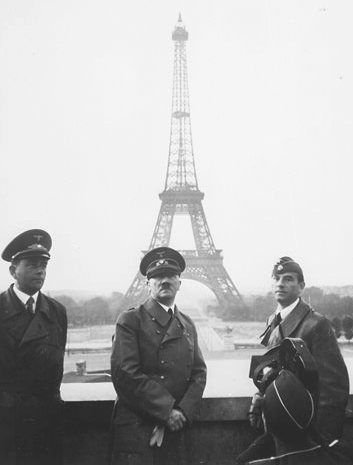
Picture: Hitler in Paris 1940.

Wednesday, September 15, 2010

A List of French Military Victories

It seems that in the last few years, many Americans cannot get enough of this joke: "List all the French military victories? Answer: There are None!" (or some variation of that.) This seems to have gotten started when the French refused to join Bush's war against Iraq.

It goes to show what a lack formal education in world history at the high school level can do to an entire country. Even university level world history in America is very one sided, if their view of Canadian history is any example.

Anyone with some understanding of Canadian history will know that this very topic comes up a lot in wartime in Canada, because our country is officially both French and English. Being an ex-history teacher, and half English and French myself, I feel that I can answer the question at least as well as most Americans.

List some of the more notable French Victories:

732 A.D.: Tours, the French hold off the Muslim invasion of Europe

If the French had not won that one, we all might be speaking Muslim today and this entire discussion would end here.

1066: French soldiers under William (the conqueror) invaded and conquered England. If Americans are not aware of this date, they should ask an English person for confirmation.

1427 Joan of Arc leads French armies in a series of military victories to save France.


1690 Battle of Quebec. This is the first major face off between the Americans and the French in the colonies. William Phips, Governor of the British Colony of Massachusetts, led an invasion against the Colony of New France (today Quebec). The French colonists won, despite the greater population of the American colonies.


1781 Two battles in one offensive: The Battle of Yorktown (American/French land siege) and the Battle of the Chesapeake (French naval victory) These two battles, one on land an one at sea set the stage for the British surrender in the American War of Independence, leading to the formation of the United States of America. Many Americans have decided that the French were of little or no help in these battles. Take a look at the casualties. Most were in the Battle of the Chesapeake, and I am guessing none of those were American.


France under Napoleon had a series of military victories in Europe. At the peak of their empire, they controlled more of Europe than Nazi Germany did in WW2, and similar to the Nazis, the French were defeated when they tried to conquer Russia in 1812. After the losses on the Russian front, a weakened French army was finally defeated.

French Victories during the Napoleonic wars:

1796 Battle of Lodi drove the Austrians from Italy

1805 Battle of Austerlitz, defeated a coalition of Russia and Austria

1806 Battle of Jena defeated Prussia (today Eastern Germany)

1809 Battle of Wagram French defeat Austrians


Now just for some balance, lets look at the historical French Defeats, as told by an American humour website.

Basically, as most of the arguments go, any French victory was either led by a foreigner, or a woman, or was too long ago, or they won a battle but lost the war, or had help from somebody else, and therefore doesn't count. Therefore, the French are cowards. Just a reminder, it is battles, not wars that are usually won or lost on bravery or fighting skill. The winning of wars also depends on depth of resources and strength of the economy, and geographic issues.

One of the most famous French defeats was the Battle of Waterloo in 1815. The U.K. and their allies (most of what is Germany today) vs. France.

Even worse was France defeated by Nazi Germany in 1940. At the end of this battle, France was fighting alone against Nazi Germany. Their allies Belgium and Holland had surrendered. The Soviet Union had signed a peace deal with Hitler. The British had evacuated their troops back to England. America was neutral, or helping any side that could pay for it. Italy joined in on the side of the Germans following the British withdrawal. At the end of the war, Americans found out that it was tougher than they thought to beat the Germans. Most of the heavy work was actually done by the Soviet Union in forcing Germany to surrender.

By comparison to the defeat of France, the Russians did not surrender when the German Army invaded. However, in stopping the Germans, they had 800,000 soldiers killed and 3,000,000 injured. The Russians also had the advantage of a large territory to retreat into, and a long hard winter to slow down the Nazis.

A major recent French defeat was in Vietnam. The French asked the US for assistance, but instead the US decided they could do better and went at it alone after the French withdrew. Most people agree today that the US did not do any better than France in the Vietnam war.

Here, from an American writing on a Chinese website (I'm guessing, see for yourself on the link), is a quote
"But there are two things I hate more than I hate the French: ignorant fake war buffs and people who are ungrateful. And when an American mouths off about French military history, he's not just being ignorant, he's being ungrateful."


http://www.napolun.com/mirror/napoleonistyka.atspace.com/bayonet_battles.htm#hatefrance


Further reading: French Army 1600-1900

http://www.napolun.com/mirror/napoleonistyka.atspace.com/FRENCH_ARMY.htm

Thursday, August 26, 2010

What Lessons Did We Learn From the Treaty of Brest-Litovsk?

While reading about World War 2, one of the puzzling things from a Canadian perspective, is the Nazi attack on Russia, while they had England and France down. Then, another puzzling development, the war against Russia, where the initial German advance was turned back after its defeat at Stalingrad. In the final analysis, it seems it was the USSR that beat Germany, judging from the number of German soldiers they killed. Although statistics vary, the Soviet Union probably accounted for more than 70% of German casualties.

As I was reading about this struggle between Germany and the USSR in WW2, I kept coming across references to the Treaty of Brest-Litovsk. If I ever heard about this treaty before, I promptly forgot about it. It only took effect for about a year, and was torn up when Germany lost WW1.

http://en.wikipedia.org/wiki/Treaty_of_Brest-Litovsk

The Treaty of Brest-Litovsk was the peace treaty signed between Germany, and the Soviet Union. Basically, it was a complete surrender by the Communist Soviet Union, which at the time had just been formed after a civil war where the Czar was deposed.

In the Treaty of Brest-Litovsk, the Germans (and their allies, including Turkey and Austria) demanded a huge amount of territory from Russia, including the Ukraine. The Soviet Union lost a quarter of its territory and people, and 90% of its coal mines.

The Russian delegation at the peace talks, in the face of such outrageous demands, broke off negotiations on February 10, 1918. The Germans renewed their military offensive, and in two weeks took most of Belarus, the Ukraine, and the Baltic countries. By March 3, 1918 a new treaty was signed, officially giving these territories their independence, but Germany began appointing aristocrats to new thrones in the newly independent countries, and began sending in troops to occupy these areas.

The quick victory of the Germans was a big disappointment to the Communists. At the time, they were quite idealistic. They believed that they represented a fresh new world-wide movement of freedom and equality for the common man. They had hoped that the workers of Germany would support them in their quest for peace and economic justice. However, the German workers did not rise up to disrupt the Kaiser's war machine. After this humiliating defeat, the Communist movement was taken over by far more cynical leaders, who had lost all their belief in the power of noble ideas, and from that time on the Communists in Russia were pretty much a power hungry dictatorship with a sugar coating of egalitarian idealism, reinforced with brainwashing and propaganda. If that failed, the Communist program continued with mass imprisonment or executions.

Following this lightning victory of the eastern front, and the final Treaty of Brest-Litovsk, Germany moved to reinforce the western front against France, England, and now the USA, and had some initial success in this attempt. Their hope was now to go all out to win the war, but it was only a few months later, they ran out of steam and surrendered in November, ending the war, and at the same time ending the Treaty of Brest Litovsk.

At this point, much of the Russian Empire was either adrift or nominally independent. In this power vacuum, the Communists then began a war to regain their lost territory over the next few years, and they succeeded in annexing the Ukraine, which I guess would have been the biggest prize in the struggle. They also waged a bitter war against Poland.

How did the Treaty of Brest-Litovsk set up the Second World War? For one thing, the USSR had a lot of Russian Jews in its hierarchy, and so the idea that German Jews had betrayed their country took hold. Hitler believed this, and eventually Nazi propaganda convinced most of Germany. The second point is that Germany had, through a quick military victory, actually taken the Ukraine and most of Eastern Europe, so it was easy for the Germans to imagine that this territory could be retaken just as easily, and probably even belonged to them. For Germany and the Nazis, WW2 was all about punishing the Jews for WW1, and retaking the lost territory of the Treaty of Brest-Litovsk.

On the west, the Germans never really had any illusions about permanently occupying England or France. If Britain and France had not interfered, the second world war would have been between Germany and the USSR alone.

Picture: From left: From Communist delegation Lipski, Trotsky, unknown person, Joffe from this web page.

Thursday, August 19, 2010

How to Live Through A Bombing

I have never lived through a bombing in Canada like the one on 9/11 in New York. But I do know someone who lived through the World War 2 bombing in England, and she does not seem to be anywhere near as crazy as some right wing extremists in the USA. This person is my mother, and until recently I had not taken much interest in her experiences in WW2. So I asked her to fill me in on what happened the day they were bombed out of their house, and I thought I would put this in my blog, because it's kind interesting.

My mother, Joyce, was the second youngest of 7 children, and 15 years old at the time their house was hit by a bomb. Her family lived on Humberstone Road in Leicester, a city in the middle of England. The bomb did not make a direct hit, and they were in the basement, so nobody in the family was killed. But many other people were killed by the bombs that night and the next.

The main Leicester blitz was two nights, the 19 and 20th of November, 1940. This was a major offensive against this particular city. The rest of the war, bombing of Leicester was more scattered.

The night of November 19, the family was sitting around the table having supper, and her brother Ray had just returned from a day of work at a munitions factory. He was a bit late and started supper just as the rest were finishing up. Her older sister Kitty, who lived a few streets away, arrived, asking why they were not in the basement, as there was real air raid going on. They were not paying much attention as there had been a lot of false alarms so far during the war. Everybody quickly moved downstairs to the basement, and not long after, a series of three bombs struck the neighbourhood in a straight line pattern, one after the other. One of these bombs destroyed a factory behind their house, and sent brick rubble crashing into the room where they had been sitting just before they ran to the basement.

The next day, they discovered that the house was shaken badly enough to put all the windows and doors out of alignment, and to knock off the roof over the back bedrooms upstairs. The family would have to move, at least until the house could be repaired. The family had a guest staying with them. She was a friend named Mrs. Rodwell from Frisby on the Wreake. The morning after the house was bombed, Joyce was delegated to take Mrs. Rodwell to her son who also lived in Leicester. It should have been a 15 minute walk, but they kept coming across streets that were closed due to unexploded bombs, so the walk ended up taking over two hours. Mrs. Rodwell was elderly and it was about all she could do to get there.

No one was home when Joyce returned four hours later, and she then had to start off to find her older brother Jack's house amid all the rubble and people running around. This also took a few hours because of more closed streets.

Although several factories were largely destroyed, the biggest damage caused by an explosion (as opposed to fire), was a parachuted land mine that hit the building of Messrs. Steels and Busks Ltd. On St. Saviour's Road, the next night (the 20th). The factory made ladies corsets, which seems to not be mentioned in any of the historical records I saw. However I guess if you know the word busk means a part of a corset, then it's obvious.

In the days that followed, everyone found a longer term place to stay. Joyce, who was working at the time, was offered a room to share by a co-worker. The various other sisters and brothers moved off to live with relatives, while Veronica, the youngest, stayed with her parents. My grandparents owned a cottage with a garden plot just at the edge of the city where they grew vegetables. They would use it as a make-do shelter until they could buy something else. It had a sink, an outhouse, and a wood stove.

Everyone went back to work, but Kitty didn't like what she saw. Near her office was the burned skeleton of a night watchman still at his post. I personally find some of these stories kind of shocking, possibly stretching belief at times, but hey, it was a war and people really did die. Stranger things have happened.

It took a few months for my grandparents to find another place to live, during which time their damaged house was looted of rugs and curtains, and the water pipes burst.

By January, the family finally was able to buy a new home in the village of Kilby, it was the 300 year old pub called the "Dog and Gun". The day they moved in, Joyce showed up at the pub, looking forward to seeing all her family again, but met her mother in the middle of unpacking, who impatiently asked her if she couldn't have stayed a few more days in the city while she got the house/pub ready to live in. My mother said she was somewhat put off by the welcome, but it was understandable. The first night at the Dog and Gun, it snowed, and water leaked on to the bed she was sharing with Veronica. Some of her sisters hated living at the Dog and Gun, but Joyce did not mind, although it was a seven mile bicycle ride to Leicester. Her father did not have enough petrol ration coupons to drive to the city, so he sold the family car and bought a pony and trap in order to bring supplies to the pub, which they continued to run as a business.

It took two years to finally get the house repaired and moved back to Humberstone Road in Leicester, but the repairs were not good enough and finally the house was pulled down entirely.

Near the end of the war, my mother married a French Canadian soldier, and moved to Canada. Her father died a few years later. She is now the only living member of her family, and is 85 years old.

According to this website, surprisingly, the corset makers Steels and Busks are still in business in Leicester. The last time I was in Leicester, in 1989, I visited the "Ladies Underwear Museum", which I suppose I don't need to add was very interesting.


Picture 1: Back in 1939 when this picture was taken, both my uncles rode Rudge Ulster motorcycles, made in Coventry. The motorcycle on the right has my uncle Ray and my mother at 14 years old. This was just before the war started, and a year before they were bombed out. Alf, on the other motorcycle died of a brain tumor before the bombing. The picture is taken behind their house on Humberstone Road.

Picture 2: Taken from a book "Leicester Blitz Souvenir", shows Humberstone Road on Nov. 20th with the family's house outlined in a red pen. Click on the picture to zoom in.

Some first hand accounts of the Leicester Blitz:

http://www.wartimeleicestershire.com/pages/memoirs.htm
http://www.wartimeleicestershire.com/pages/memoir_files/48.htm
http://www.wartimeleicestershire.com/pages/memoir_files/43.htm
http://www.wartimeleicestershire.com/pages/memoir_files/35.htm (Steels and Busks Engineering Factory?)
http://www.wartimeleicestershire.com/pages/memoir_files/33.htm
http://www.wartimeleicestershire.com/pages/memoir_files/30.htm

Wednesday, May 26, 2010

Travelling to a Small Town in Ontario, Canada, in 1914

In the last year, Mary Ann and I have made efforts to discover our local area in day trips by car, motorcycle, walking or bicycling. Yesterday, we found one of those places that I would put near the top of the list. It's a place I pass by every time I go to Port Dover, or almost anywhere actually, called Doon Pioneer Village. I did visit the place about 30 years ago, and have not been back since then. In fact I used to enjoy visiting pioneer villages, and have seen several including Drummondville Quebec, Upper Canada Village, and Black Creek Pioneer Village in Ontario. 

But the occasion yesterday was much better than I remember, and possibly hard to match at any time. First of all, it was free for us yesterday. The new Waterloo Region museum will be opening soon on the site of the village, and this is actually quite a big museum, of the size you might normally only find in larger cities. So the museum held an open house for the Historical Society and their guests, and lo and behold it appears that Mary Ann got invited and that was extended to include me. Not only free admission, but free punch and snacks at the museum, and free access to the Pioneer Village.

At some point Mary Ann and her friend were talking shop, and I decided to go outside to check out the steam locomotive parked at the edge of the outdoor cafe patio. I am somewhat interested in trains, I guess part of my mechanical interest that also draws me to motorcycling. When I finished looking over the engine, I noticed a restored train station beside it. It looked like there was no one around, and the door to the main waiting room was unlocked so I decided to poke around. I went in and was looking at some of the posters on the wall when I was startled by a voice behind me asking "Would you like to purchase a ticket to somewhere?" I recovered enough to look around and found that there was actually a woman behind the ticket counter, dressed in an old fashioned costume. I said "Maybe, where does the train go?". Then she showed me a map of the Grand Trunk railway tracks in Canada in about 1914, and a similarly dated schedule of passenger services and fares. It seemed like I could probably get to Vancouver, British Columbia for about $5, which I had in my wallet, and this price was quite a bargain.

After we talked for a while about the history of the Grand Trunk railway, I made my way back to Mary Ann and told her the strange tale of this women trying to sell me a ticket on the train. According to Mary Ann it was nothing supernatural, it was merely one of the tour guides for the pioneer village. I said there is nobody in the village, I think it's closed today. So the three of us decided to go out and stroll about the village, and although we didn't see any other tourists, every building was fully staffed with costumed guides. All we needed to do was walk in to a building and talk to them. All three of us were interested in history so we had lots of questions. For example, I was asking about the unusual electric light bulbs in the general store. Apparently, they were supposed to look like they dated back to about 1914, which was about the time that this area first started getting electricity. I'm pretty sure they were not original pieces, as they were all working, and all turned on.

Another place we visited was "Peter McArthur House". He was apparently quite a famous writer for the Toronto Globe in 1914, and lived in this house near Appin, Ontario. The house was moved to Doon Pioneer Village some time ago. I never heard much of this Canadian writer, but I took a look at some of his work, and I like his style, which was a blend of Stephen Leacock-like humour and serious political commentary. He tried to promote farming as a way of life, and was an informal spokesman for the "back to the land" movement, at a time when farmers were heading for the cities in droves. Looking back from 2010, he was apparently not that successful in his quest to stem the tide.

I found a long article about him here.
http://findarticles.com/p/articles/mi_qa3683/is_200704/ai_n19432203/

It was like a trip back to 1914, the target date set by the pioneer village. I'm not sure how much I would like visiting the village again with bus loads of schoolchildren around, but it is a place we will go back to see again, especially if we have some out of town visitors staying with us. Or maybe even some in-town friends or relatives (like my grandchildren maybe, except they keep saying they have already seen everything I take them to - they have been on many class trips).

Picture: The Stanley Steamer club photo, when they visited Doon Pioneer village in 1999.

Friday, April 23, 2010

The Connection Between Abolitionists and the War of 1812

The War of 1812 might not have happened without the Slave Trade Act of 1807.

In 1807, the British Parliament passed a law against the slave trade, although not against slavery itself.

This law came after many years of a campaign for the abolition of slavery that had been fought in England, led by William Wilberforce. The abolitionists really wanted the end of slavery, but their motions were defeated year after year.

In 1807, Britain was at war with France, and no British ships were allowed to trade with the French. Many British slave ships had converted to the US flag in order to continue selling slaves to French colonies. The slave trade was particularly important to the French Colonies, because the slave ships that sold the slaves also transported the sugar that the colonies produced.

The abolitionists backed an anti-slave trade law that was promoted as a way to cripple France's trade. The Slave Trade Law of 1807 said (among other things) that it was illegal for any British subject to be involved with the slave trade.

While researching this aspect of history, I was confused about the actual enforcement. On the internet, I found references to slave captains being fined a fixed amount for each slave aboard their ship, which apparently led to slave ship captains throwing slaves overboard to avoid fines. On the other hand, the Slave Trade Act of 1807 clearly states that any slave ship shall be forfeit.

http://www.pdavis.nl/Legis_06.htm

Also confusing was the fact that the Americans passed their own law against the slave trade the same year. But they were not in a position to vigorously enforce their law, like the Royal Navy was. Also, the war between Britain and France encouraged the enforcement of the anti slave trade law by Britain.

In any case, it resulted in increased searches and seizures of ships flying the American flag, by the British navy.

There is also a connection with Sierra Leone, as the city of Freetown was the place that slaves on seized ships were set free by the Royal Navy.

Royal Navy ships continued to stop and search American ships for several more years, and became one of the well-known causes of the US government declaring war on Britain in 1812. What is not so well known is that there was a connection between the war of 1812, and the campaign to abolish the slave trade.

The abolitionists' campaign carried on, and eventually, the actual practice of slavery would be declared illegal.

Saturday, February 13, 2010

A Lesson from The Flat Earth Wager of 1870

Once again I want to call into question whether debating should be used as a technique to settle arguments about the validity science. For example, Creation vs Evolution, or whether global warming is real or a scientific hoax.

I have been reading the book "Flat Earth, the history of an infamous idea" by Christine Garwood. There is a historical precedent that we might be able to learn from that we can generalize to all science vs. non-science arguments.

This historical debate was about the flat earth in 1870. It involved AR Wallace, who was coincidentally the co-discoverer of evolution.

A. R. Wallace took up a monetary wager against flat Earth promoter John Hampden. To win the wager, Wallace had to prove, to the satisfaction of a third party referee, that the Bedford Canal had a curve to its surface.

Wallace set two markers at a height of 13 feet above the water, one was at 5 km., the other at 10 km. He then used a professional surveyor's telescope with cross hairs, also at thirteen feet height and observed that the furthest marker was lower than the middle marker, by about 4 feet. The previously agreed impartial observer, William Carpenter, was then allowed to look through the telescope, at which point he joyously declared the points lined up therefore the canal was flat. No amount of persuasion could convince the observer that the middle marker was higher than the furthest marker.

Finally after days of wrangling, another judge, Walsh, was chosen, and he said that the difference in height of the markers clearly indicated curvature of the canal water surface. Furthermore, Walsh discovered that William Carpenter, the previous referee, was a close associate of John Hampden, and Walsh issued a statement in which he included the comment "The deception was, to say the least of it, 'unscientific'." (speaking of the choosing of William Carpenter who did not disclose his close collaboration with Hampton)

As a result of this comment by Walsh, John Hampden claimed that he was being libelled, and also accused the new referee of colluding with Wallace. Hampden took legal action to prevent the wager money being given to Wallace. After years of fighting in court, A.R. Wallace won the money, but ended up no further ahead after lawyers fees, and had done nothing to stop the spread of the "Flat Earth" philosophy.

What we can learn from this, is that scientists and anti-scientists do not have the same standards of fairness. Why would I say that, and how could I ever confirm it? Of course it can never be confirmed that anti-scientists are all cheats, and it does not even seem to be a reasonable statement. I would go further, and say it makes me sound like a lunatic that I would even propose that all anti-scientific people are liars and cheats. Therein lies the paradox that prevents a debate from being a good way to settle the matter.

For any debate to succeed, you need to have both sides willing to listen to reason, to abide by observed facts. But that very idea is at the heart of "The scientific method". If you can show me two people willing to listen to reason, and abide by observed facts, I will show you two scientists.

But the world at large, observing this debate, sees only two equally earnest sides, pro science vs. science deniers. If the pro science side ever at any time in exasperation, insults the science deniers for their lack of logic, for their hardball tactics, for their deceit, a whole new argument is launched. This new argument is about personal honour. In the new argument, the scientists were the first to insult the other. And they lose.

Thursday, January 28, 2010

The Day the History Died


Howard Zinn, an American historian who opposed the Vietnam war died on Wednesday.

Last week, Glenn Beck, an opinion giver on Fox News decided to rewrite history, starting with World War two, in a one hour special. His purpose making "Revolutionary Holocaust: Live Free or Die", is to set people straight, explaining that Hitler was actually a left wing, not a right wing dictator. And to furthermore prove that the Progressive movement in the United States is going the same direction as went Hitler, Mao, and Stalin.

We didn't have enough headache pills, so I was not able to sit through the entire hour, but I did see a little bit of it.  At first I could not understand why the shocked tone, as Glenn Beck explained that Hitler and Stalin both invaded Poland at the same time. Then I realised that his audience would probably have never heard of that part of WW2, as most Americans are taught in school that WW2 started at Pearl Harbor. So no wonder he made it sound like this was some kind of secret thing that had been covered up for eighty years.

Maybe I have a slanted view on this because I taught history myself, but I really think Canadians would probably know something more about the invasion of Poland than Americans. That is because, if nothing else, people in a country are taught about what got them into a war. For the US it was Pearl Harbor. For Canada it was the invasion of Poland. Oh, sure you can find the occasional American who never heard of Pearl Harbor. And you can probably find even more Canadians who don't know about Hitler's invasion of Poland. But I'll bet a lot of Americans are like Glenn Beck, who probably just found out about Poland a few weeks ago.

I found the Glenn Beck special to be quite confusing historically, but technically excellent propaganda, even by Nazi standards, if the aim is dividing Americans against each other.

Glen Beck did bring up one new fact I was not aware of. There are a couple of quotes by George Bernard Shaw, where he suggested gas chambers be used to kill people. This was before Hitler even thought of it. Beck further linked George Bernard Shaw to Obama by revealing that both had won the Nobel prize. (Though Shaw's was not for peace, obviously). And he linked Shaw even more closely to Al Gore by noting that both of them had won an Oscar and a Nobel prize.

I looked up the quote, and apparently it is true. Actually I kind of expected it to be true, because bizarre revelations like this do not work well if they are wholly fabricated. I don't claim to know what G.B. Shaw was thinking when he wrote that stuff. Maybe he was thinking what I'm thinking, which is let's set up gas chambers for all the Glenn Becks of the world. Or maybe he was being funny, or maybe he was being serious. For sure GB wrote it before Hitler thought of it, and the world was so horrified by Hitler's actions that we have recoiled from many ideas that were commonly held even before the Nazis came to power. (such as racism for example). And to be fair, Shaw wrote over 13,000 letters in addition to his literary work. I'm sure you could find something to support almost any position in there. By comparison to my one year blog (where you can already find enough material to send me to jail forever in some jurisdictions, and to hell for eternity in the rest), I have only 300 entries so far. Imagine all the self incriminating stuff I could write if I had another forty years to go at it!

What was especially funny to me, was that the G.B. Shaw quotes were kind of wasted on Glenn Beck's target audience, as none of them had ever heard of George Bernard Shaw. And their comments on Youtube indicated that Beck had forgotten to mention that Shaw died a long time ago. So it is possible even for Glen Beck to overestimate the intelligence of his audience.

Howard Zinn died and passed on the torch to a new generation of history teachers, who apparently want to use history to promote hate against their fellow citizens. Glenn Beck, please, if you are reading this: Promoting hate is much closer to the evil stuff  of Hitler, Stalin, and Mao, than is promoting health care.

Here is something else GB Shaw wrote, also prescient.

"It is said that every people has the Government it deserves. It is more to the point that every Government has the electorate it deserves; for the orators of the front bench can edify or debauch an ignorant electorate at will. Thus our democracy moves in a vicious circle of reciprocal worthiness and unworthiness."


Picture: G.B. Shaw wrote a famous play about Joan of Arc that I studied in high school literature. I can't wait for the Glenn Beck to do a special on it.

Sunday, January 24, 2010

The Rise of Evangelism

It is difficult to write about the history of Evangelism without bias. You either believe devils work among men, or you don't. I am not a believer, I may come off as biased. Because this debate is still ongoing, claims and counter claims are flying around. For example claims that science is actually religion in disguise. Other claims that our scientific advances are based on biblical knowledge, or that atheistic scientists are holding back the advance of technology. There is another accusation, that the age of reason has made possible horrors such as the Nazi holocaust.

I'm going to make the assumption that science is actually science. Religion is actually religion. Science mostly looks at nature, needs evidence and uses logical reasoning. Religion is based more on emotion, faith, and the supernatural. And considering the various types of religion, the Evangelicals use more faith and emotion than many others. Evangelicals also try to explain our natural world in terms of supernatural forces.


The Rise of Evangelism

The growth of a new way of thinking, whether a religion or scientific theories, can be studied in the same was as the growth of a plant or animal species. The new idea needs a method of reproduction, whether by birthrate or by new converts. It "lives" in an environment made of people with their own understanding of the world, with ideas, hopes, fears, and myths. A new way of thinking has competition from contradictory ideas, and always faces resistance from the the powers that be. It has adaptive measures to help it survive, the way a living organism would, including camouflage, defensive and offensive capabilities, sharp senses, intelligence, or speed. And success is measured by growth of population, or survival.  Much of the success depends on how good the adaptive measures are, how well they fit the environment, how fast the species can adapt to changing conditions, and how weak the competition is.

I am reading the book "Southern Cross" by Christine Leigh Heyrman, the history of Christianity in the southern US bible belt published in 1997.

The book reads like a university History course textbook. It starts off in the time before the American War of Independence, when the Evangelicals were a small minority in the south, and the Anglicans were the established religion.

It is the story of a small fringe religion that became a dominant force, and reading this book helps to understand how it grew.

There were many factors that worked in favour of the Evangelicals. Because it was a small, decentralized religion with a very loose hierarchy, the various itinerant preachers were free to experiment, to modify, to adapt new ideas. Each preacher could see what worked and what didn't. Those that stumbled across ideas that worked, would thrive. Others dropped out and were forgotten. Each preacher had plenty of enthusiasm unhampered by orders from the boss. Each one was his own "boss" serving God, not man. Motivation among them was very strong.

To encourage rapid growth, Evangelicals dropped the requirement that Pastors have any higher education.  This gave them an edge in recruiting new pastors to travel to poor pioneer communities, but also let a some ignorance and superstition creep into their religion.

The old Anglican Church was a monolithic hierarchy, slow to change, unwilling to adopt new ides. Additionally, because Anglicans were also the official religion of England, they lost much of their "official" status after independence. They did their best, but did not have the extraordinary motivation of the Evangelicals to find converts. Meanwhile, the energetic Evangelists were travelling miles up-country as America began to expand into former Indian territory.

The main idea of the old Anglican church seemed to be, go to church and keep quiet. If you have problems, keep them to yourself or pray silently. It did not ask its members to seek out new converts. Why would it need to, as the dominant church?

The Evangelicals were a more emotional church. They took the approach that everyone had burdens that were too much to bear, physically, spiritually, and mentally. They promised to relieve you of those burdens, if you accepted their Jesus.

The Evangelicals also were were evolving quickly, and adapting to their environment. The basic approach was improved and retuned as the church grew, and evolved in an almost organic way. The theology and the ideology changed, methods were tried and adopted or abandoned. These changes happened relatively quickly among the Evangelicals compared to an established religion like Roman Catholic or the Anglican Church.

The Environment

Many of the adaptations were made to appeal to the settlers of the south, especially those who lived in the mountains or in the new frontier. The Evangelical religion grew in the back country and in the coastal cities. Some people had very little education and some were completely illiterate, such as the black slaves who were permitted to attend meetings (when the Evangelicals opposed slavery).

The population of the south was made up of European immigrants (Irish, Scottish, English and some others), black slaves, and free black men, and some native Indians. There was a strong current of superstition, witchcraft, spell casting, ghosts, and demons both visible and invisible. Every natural phenomena was sent by the devil, from earthquakes to eclipses of the sun. It was known that witches transformed into animals that could not be killed by anything but a silver bullet. People feared not only real hardships, but also the evil eye and curses. They often turned to fortune tellers and witch-doctors to make or break spells, and to faith healing. They feared unlucky Fridays, and magical numbers.

The Evangelicals tapped into this superstitious tendency, and made it fit with their interpretation of the Bible.

The Evangelicals made it a priority to bring in converts. The basic approach with potential recruits was to sympathise with their superhuman burdens. Apparently there were more than enough people with unbearable burdens, so this touched a real nerve. Next step was to offer relief, through Jesus. The Evangelicals could explain almost any problem a person was having, in terms of the devil or God. They had all the answers, including miracles, faith healing, and eternal peace of mind. They also were usually ready with excuses in case some of their wilder promises did not work out as planned.

Adapting quickly

You would not expect such a religious system to work in every case, and it didn't. But because the Evangelicals were a loose organization, the unsuccessful pastors could fail without reflecting too badly on the reputation of the rest. The successful ones could be emulated, and help the others. If things went wrong, it was not a reflection on the whole movement, just another bad preacher who deserved to fail because he was not a true believer.

The general ideology centred on the bible as the ultimate authority, and on rejecting the newly developing ideas of science.

Some Evangelical pastors were opposed to such heavy emphasis on superstition, and those same people were regularly accused of being in league with the devil. As Evangelism grew, its ideas evolved in the direction of the supernatural. Evangelism eventually turned more towards witchcraft and devils to explain the bad things. Their main argument for conversion, was based on the idea that people were suffering in some way, mental, or physical. And the Evangelicals would explain the suffering in terms of witchcraft or the devil. They offered salvation by baptism to their religion.

Their persuasive arguments were backed up with stories of miracles, scenes of people being converted, falling to the floor screaming and shaking with the spirit of God or the Devil. It had a powerful effect on many people in the south of the USA and on the frontier, where they were suffering the hardships of pioneer living, some facing the terrors of Indian attack, some living in fear of a slave uprising, and very few with any access to education.

The Evangelicals came in for much ridicule from more educated people, and shrugged it off. They successfully made such ridicule fit their self image of being persecuted for Jesus.

The Evangelicals' initial successes were among the young, and the females. This had a tendency to undermine the unity of families. Later, as they expanded their base, to gain more converts "they catered to adult, male-dominated family order (while still proselytizing youth and women); and they supported the rightness of slavery and racial hierarchy, willing to lose African American followers if they gained white ones." Steven Stowe, Indiana University

A review of the book "Southern Cross" claims the author is distorting source material

A quote from Southern Cross said the Evangelicals "wanted to have it both ways - to discount the sway of demons and wonder-workers even as they played upon the susceptibilities of those who still inhabited a world shot through with marvel and mystery" p. 75-76

Christine Heyrman gives this following quote from John Wesley, (one of the fathers of Evangelism) supporting the eventual use of witchcraft and demons as a bold feature of Evangelicalism (I paraphrased this quote)

"Most learned men in Europe have given up all accounts of witches and apparitions as mere old wives' tales for they well know ... that giving up witchcraft is in effect, giving up the Bible; and they know that if but one account of the intercourse of men with separate spirits be admitted, their whole castle in the air falls to the ground."

So Wesley concludes that they should retain this weapon of witchcraft in the hands of their church.


Struggles within the Evangelical Church

There were two basic struggles within the church that were ultimately decided because of their appeal to the white people of the South in the nineteenth century.

First decision was to go with a heavy emphasis on superstition, the works of the Devil, and miracles, rather than science and reason which was becoming fashionable in Europe during the industrial revolution.

The second decision was to support slavery, which was more a matter of practicality than of scripture, and ultimately proved to be a mistake that was denounced much later near the beginning of the 21st century, when it seemed like racism was never going to return.

Although slavery is now a thing of the past, the fight goes on against science, especially in the teaching of evolution in public schools.

Picture: Religious Revival meeting in America painted in 1839 J. Maze Burbank

Tuesday, January 19, 2010

Mythbusting for Haiti

It is pretty overwhelming to see what is going on in Haiti. But absolutely revolting to see the heartless attitudes some people take toward this tragedy. I especially despise Rush Limbaugh saying that nobody should give a penny to the Haitians. 

I saw some comment like:
"What do they expect, they live in little tin roof shacks, of course they are going to be killed in an earthquake"


Fact: You are actually far less likely to die in an earthquake when you live in a miserable shack held up by broomsticks and twine, than you are to be killed when a larger multi story cement structure, probably built during the American occupation, collapses on your head.

Pat Robertson made a lot of errors in his condemnation of Haiti. The "Pact with the devil" they made to get free from France? I have gone over the pact with the devil contract before, it does not hold up to any scrutiny. I don't expect any truth from someone who believes in Adam and Eve anyway. But please, they were not fighting to be free of France. They at first wanted to remain a colony of France, and only to be free of slavery. Toussaint Louverture, their early and successful leader, wanted to negotiate for the end of slavery and remain a colony of France. But he was captured at the official negotiation, by the French, and sent to France where he died of disease in captivity. He was actually lucky, almost every other leader who stood up to the French was burned alive or tortured to death upon capture. It was only after these talks broke down, that the Haitians were forced to choose new leaders and decided to fight again for complete independence, against the treacherous French.

Another big question Pat raised, why are Haitians so poor, when right next door in Dominican Republic people are wealthy and happy? He reasons it's all about the "pact with the devil" which I actually find an improvement over many of the racist slurs other people make to explain the poverty.

Why is Haiti poor? After Haiti's independence, the French refused to trade with Haiti, and no other country would or could trade with them either. Either for revenge, or because of the so-called pact with the devil, of for pure racism. Anyway, no trade, no money. After a number of years of near mass starvation, the Haitians negotiated with the French, who were also hurting a little by this time, as Haiti had been a major source of wealth for them. The French offered a deal, take it or leave it, that the Haitians would have to repay France for every bit of land they took (the entire island of Hispaniola), and the full market price for every slave on the island who was freed by the rebellion, (almost the entire population) and all damages cause by either side in the rebellion. Ask yourself how this compares to the terms England gave to America after the war of independence. You may have to read up on that history again, but I'm sure you will not find reparations or trade embargoes. The Haitians were saddled with paying off a staggering debt, including extremely high interest rates from 1826 to 1879. So don't make disparaging comments about Haitian poverty if you don't know anything about their history.

Is there more? Of course. The entire Island of Hispaniola, for a time was under one government, but in 1844 considering the burdensome deal made with France, half the island split away, leaving the people in the Western half of the island (today Haiti) to pay the entire war reparations to France without the help of the Eastern half, now called Dominican Republic. That's the "wealthy" part that Pat Robertson compares to Haiti to "prove" there was a pact with the devil. Apparently, in Pat Robertson's eyes, poverty proves you have a pact with the devil, even when people are taking money from you unfairly. And by the way, the Dominican Republic is not actually paradise on earth either.

Another myth to dispel is this: That the people of Haiti are congenitally incapable of running a decent country. Either through stupidity, or pacts with the devil or whatever, the myth is, the Haitians just can't do it. Well just read up on their history, and you will find there was a period of time (approximately 1867 to 1911) when the Haitians actually were turning their little country into a nice place to live, even with with a growing intellectual class, arts and literature. Peace and stability were the norm. But after about forty years of this, the Germans thought Haiti might be a possible colony in about 1911, and the Americans retaliated by invading and brutally occupying the Haiti. Since then it has been either outright American control, or American puppet dictators, more or less steadily. Later in this dictatorship phase (especially in the last 20 years), many of the most wealthy and educated Haitians emigrated to Canada or the USA, leaving the rest to deal with it. Not the best of conditions to try to run a good country.

Then this earthquake, and all of a sudden racists pop out of the woodwork with their opinions that do nothing but show their own ignorance and lack of either education or heart.

Now I see a video on CBC News  of a Canadian teenage girl in Haiti crying. Why? Because she and a group from her church were in Haiti during the earthquake, on one of these volunteer trips, doing some humanitarian work while visiting a developing country. She was crying, overcome with emotion of seeing all the dead bodies, hearing the screaming people trapped in the buildings, and yet in the middle of all this, their Haitians hosts were still doing their very best to make sure the Canadian guests were safe and taken care of.

How about if we just give these people a break for once?

Top picture: Haiti, taken from a travel blog here:

http://jeffandlauratravel.wordpress.com/category/travel/haiti/

Monday, November 2, 2009

Making Sense of History: Connecting Quebec to Freedom of Religion

In Baie Comeau, Quebec, when I was growing up, there was an old cannon with a historical plaque that told this cannon had belonged to the American forces defeated by the French in 1690, under the command of William Phipps. What was missing was some of the background of the story. Strangely enough, this defeat for Phipps was almost directly connected to the first Amendment in the American constitution, which guarantees freedom of religion.

In 1690, the Massachusetts colony was still largely Puritan, and still executed people for witchcraft.
Williams Phipps was appointed commander of an expedition in 1690 to conquer Quebec, but was defeated. In 1692, after his defeat at the hands of the French, his next big claim to fame was appointing a commission to try the Salem witches. Nineteen people were executed, and in the revulsion that followed this travesty of justice, came the virtual end of the Puritan religion in America.

Less than a hundred years later, the US constitution was written and by connecting just a few historical dots, you can assume the "Separation of Church and State" owed much to the fear of religious extremism following Salem.

But though the Puritan name has disappeared, the core values of Puritanism have not really disappeared in the USA. In the year 2009, we still have several major religious groups in the USA, who inherit much of their core beliefs to the Puritans.

If you would like to see how similar your own religion is to the Puritans, try this questionnaire. If your church scores full points on every question, you might as well be fresh off the Mayflower.

  • You believe in faith healing
  • You believe that prayers are answered with material gain involving some supernatural force
  • You believe that witchcraft exists
  • You believe that the cure for witches is execution.
  • You do not believe that doing good work is necessary for going to heaven
  • You believe that every word of the Bible is true

Now interpret these passages according to your religion, what do they mean?
Psalms 2:8:
"Ask of me, and I shall give thee, the heathen for thine inheritance,
and the uttermost parts of the earth for thy possession."

  • Do you believe this gives God's chosen people the right to dominate all the Earth?
  • Do you believe you are God's chosen people mentioned in this passage?
  • Do you believe this gives the chosen people the right to use superior firepower to exercise this domination?
  • That this word "domination" permits massacres of native women and children.

First Chronicles 16:30
"Fear before him, all the earth: the world also shall be stable, that it be not moved."

  • Do you believe this quotation means the Earth does not move through space?
  • You believe the end of the world is coming with the return of Jesus
  • You believe that the Earth is less than 7000 years old.
  • You believe that God created man in his image, and Adam was the first man (explanation, this took place before the age of Darwin, and there was no theory of evolution., But but if they had know about it, the Puritans would almost certainly have disapproved of Darwin.)
  • You believe that women were created to serve men and obey them.
  • You believe that dancing is evil
  • You do not believe in the separation of Church and state


Generally, when teaching history, the events of the invasion of 1690, the witch trials, and the writing of the US constitution are treated as entirely unrelated. But if Phipps had succeeded in his invasion, there would never have been any witch trials. I suppose this is debatable, but typically a victorious people tend to behave differently from a people who upon losing a war, are now required to pay for it. I would argue that the Americans would have been far too busy revelling in their victory than stewing about their defeat. So, in my opinion, if Phipps had succeeded in taking Quebec, there would be no witch trials. With a military victory behind them, the Puritans would have been a force in American politics for the next 50 years at least. Also, quite possibly no American revolution would have taken place. But instead some people in Salem retreated into extremism and what you might even call some delusional behaviour.

The modern, conventional view is that the Salem Witch trials were a weird anomaly of American history. They were quaint, and the only lessons we can take from them are the McCarthy anti-communist campaign, and the anti-gay campaign when AIDS first appeared. Both were referred to as "Witch Hunts". But no mention is made of the fact that many existing right wing religious groups are based on Puritan ideas, and still believe in witchcraft.

People today find it amazing that back then they believed in witchcraft in this video

Parallels are made to the McCarthy era communist-hunt, and persecution of homosexuals
http://www.salemwitchmuseum.com/education/index.shtml
http://www.salemwitchmuseum.com/about/exhibit.shtml

William Phips who tried to conquer Quebec and was defeated.
http://en.wikipedia.org/wiki/William_Phipps

The following history web page tries to explain why the witch hunting frenzy took place, mentions everything but the fact that they were Puritans.

"Why did this travesty of justice occur? Why did it occur in Salem? Nothing about this tragedy was inevitable. Only an unfortunate combination of an ongoing frontier war, economic conditions, congregational strife, teenage boredom, and personal jealousies can account for the spiraling accusations, trials, and executions that occurred in the spring and summer of 1692."

Friday, October 23, 2009

What is the UN?

There is the popular expression "unless you've been living in a cave" and its' variant "Unless you've been living under a rock". Each one means that you are ignorant of something that everyone else is aware of.

There are a lot of things that some people do not know about the United Nations. This week, Jay Leno discovered this on his usual Jaywalking segment.

Jay: Where is the U.N. Headquarters?"
Jaywalker: Switzerland.
Jay: How many countries are in the U.N.?
Jaywalker: Eight?
What interests me is not so much how Jay finds these Jaywalkers, but in how he keeps coming up with unexpected questions that reveal their lack of awareness of the world around them.

So the correct answers would be: UN Headquarters are in New York City, and there are currently 192 countries that are members of the United Nations. (Answers that would also have been accepted "1. America and 2. All of them") But actually, there are some sovereign nations that are not part of the U.N., Vatican City, Palestinian territories, and Western Sahara. Also some other "countries" are excluded because they are claimed by a recognized member of the UN. For example China says Taiwan cannot be accepted as a separate country, although it actually is.

Switzerland did not join the United Nations until 2002, when it became the 190th member.

Now here is a quiz to test your further knowledge, and hopefully to promote the cause of world peace through awareness.

1. Who is the Secretary General of the United Nations and is he the AntiChrist?
Ans. Ban Ki-Moon, and no.

2. Does the United Nations have a standing army, navy or air force?
Ans. No. The United Nation relies on member nations to provide peacekeeping soldiers and equipment under their own national command, to help monitor war zones where both parties agree to guarantee safe passage and recognize UN neutrality. When engaged in these operations, the "UN soldiers" wear the internationally recognized blue helmets. These soldiers are generally authorized to use force only for self defence.

3. How does the UN make decisions?
Ans. On peace and security matters, there is a "Security Council" consisting of 15 member states, of which 5 are permanent. The five permanent members are (at the present time) China, France, Russia, the United Kingdom and the United States. Each one of the permanent members has a veto, no other members have a veto.

4. Are Israel and Palestine part of the UN?
Ans Yes and no.

5. Is the very existence of the U.N. a sign of the final coming of Jesus?
Ans. No. Although, to be fair, the prophesy was that the land of Palestine was to be parted (partitioned) by all nations before Christ comes (Joel 3:2). This was fulfilled May 15, 1948, when the United Nations divided Palestine between Jew and Arab. So, the longer answer is the UN is not a sign, but the partitioning of Israel was a precondition, according to the prophesy.

6. Did the Bible prophesy the UN?
Ans. No, unless this sounds like the U.N. to you:

Revelations 13: "And I saw a beast coming out of the sea. He had ten horns and seven heads, with ten crowns on his horns, and on each head a blasphemous name. 2 The beast I saw resembled a leopard, but had feet like those of a bear and a mouth like that of a lion. The dragon gave the beast his power and his throne and great authority. 3 One of the heads of the beast seemed to have had a fatal wound, but the fatal wound had been healed. The whole world was astonished and followed the beast. 4 Men worshiped the dragon because he had given authority to the beast, and they also worshiped the beast and asked, “Who is like the beast? Who can make war against him?”

7. Is the UN part of the Axis of Evil?
Ans. No, that would be Iraq, Iran and North Korea. Although they are all members of the UN, they do not really have enough clout to turn the UN to their own evil purposes. I also wonder if Iraq is still part of the axis of evil, since Saddam was executed.

8. Is the UN an enemy of the United States?
Ans. No. The US is a veto-wielding member of the UN, so unless the US abstains from a UN Security Council vote to declare war on America, it would be impossible for the UN to become an enemy of the United States.

9. Does the UN want to take our guns away?
Ans. No. The UN does not try to get involved in internal politics of member states, and the US has a veto anyway. This myth might have been started by the sculpture of the knotted gun barrel outside the Headquarters. The "Knotted Gun" Disarmament sculpture (Non-Violence), was created by Swedish artist Carl Fredrik Reuterswärd and given to the United Nations by the Luxembourg government in 1988. Proving once again that Europeans are tone deaf to the National Rifle Association pro-gun lobby in the USA. The cowboy revolver was a poor choice of a weapon to tie a knot in, a better one would have been the Kalishnikov AK47, but maybe the Russians vetoed that one. Also the Russians supplied some UN "peace" art too, which may also scare some Americans.


Tuesday, September 29, 2009

Making Sense of Kitchener and the Twentieth Century

The smoking remains of the twentieth century are barely cooled , and already I want to make sense of what happened. I live in the City of Kitchener, Ontario, Canada. The name of this city can practically sum up the entire history of conflict during the 20th century.

It used to be named the city of Berlin, due to the large number of German settlers in the area, but bad feelings caused by the Great War in Europe led to a name change to "Kitchener", who was an English military figure. Ironically, Kitchener had something to do with the alignment of Germany vs. England in the war. For that, we can go back to the very first war of the twentieth century, the Boer War.

The Boer War in 1899, was fought between the British Empire and the free Dutch settlers of the Transvaal, in today's South Africa. At the time, Britain was the "sole superpower" as they say today. The British Empire had prevailed during the nineteenth century and was unrivalled at the time, although the rising new country of Germany had been formed out of a group of kingdoms during the 1800's.

Germany's main resentment at the time was having been left out of the scramble for colonies in Africa, due to their late arrival on the scene.

Britain's performance during the Boer War was not unnoticed by the Germans. The German view of the war was that the valiant and honourable Boers had held off a British Empire, with a force one quarter the size, and only conceded defeat in the face of inhuman atrocities by the British. These atrocities included rounding up the Boer women and children in concentration camps, where 20,000 of them died. Also, the burning of all the grazing land to deny food to the Boer horses, as all the Boer fighters were on horseback. Also, the burning of the Boer towns, and a "take no prisoners" policy where all Boer wounded and prisoners were shot (denied by the British). The person implementing these policies was Lord Kitchener, the same one that my own city was named for.

Although Britain had the ability to put a happy spin on the war for their own people back home, the rest of the world took a horrified view of the nature of the conflict. The amorality, and the greed for resources, which at this time seemed to include the rich gold and diamond deposits near Johannesburg. Also, the British Empire had put on a display of weakness as well as cruelty.

World opinion turned against Britain, you might say similarly to the second Bush war in Iraq. (Interesting note: Like Iraq, there were also two Boer wars, the first one being more successful for Britain). Britain decided to shore up their tattered image by forming an alliance with France. The Germans seemed to feel more sympathy for the Boers, given that the Germans themselves had few colonies in Africa, and that the Boers were seen by Germans as being almost like them. The language is quite similar, and the Dutch homeland shares a border with Germany. Also, the Boers were seen by Germans as heroic freedom fighters, while the British saw them as stupid and racist farmers.

Not long after, World War One pitted Germany against Britain and France, with the British portraying the Germans as a violent and warlike race. At the same time, the Germans kind of saw the British as a weakening evil empire that they were helping bring to an end. The British Empire was personified by Lord Kitchener, who was by that time, Britain's Secretary of State for War.

You know most of the rest of the history, Germany losing WW1, then losing the rematch in WW2, but by then the Germans had begun to believe the only way to win was by taking the evil route themselves, including the British idea of concentration camps. Following WW2, the entire African colonial system was broken up.

There are a couple of recurring themes to this history, leading to the current Israeli Palestinian conflict, which most obviously arose out of the holocaust of WW2. In 1899, Jewish diamond and gold agents in Johannesburg were blamed with stirring up the war against the Boers. Both Kitchener and Jan Smuts (a Boer Leader) had involvements in the Holy land. And both South Africa and Israel have been accused of apartheid policies.

The picture is a famous WW1 recruiting poster depicting Lord Kitchener.

Saturday, September 19, 2009

Making Sense of Racist Regimes

As far as I know, there have only been three democracies that developed racist "apartheid" type regimes. The Southern USA, South Africa, and Israel. I am against racism, and I consider it to be evil. I believe all citizens born in a given country must have equal rights under the law regardless of parentage. This is the law in Canada, and also now in the USA and since 1991 in South Africa. But the racist system has not yet been abolished in Israel.

As the International Criminal Court phrases it, apartheid is “the systematic oppression and domination by one racial group over any other racial group or groups and committed with the intention of maintaining that regime.”

If you wish to read more about international law and apartheid and whether or not it applies to Israel, here is a web page.

In any racist society, there is "domination by one racial group over another". There are always some people who will proudly accept their racial status (such as Black, Jew, Aryan, White) but there are many in between types who desperately want to be "certified" as part of the dominant group. So there has to be some official way of keeping up the barrier of separation.

Palestinians are officially defined by the state of Israel meaning they can never "convert" or become like the rest of the full citizens who have rights, due to their birth, and because of their official classification by Israel. The classification is based on keeping records of parentage to ensure that no one can officially move from the subordinate class to the dominant class without authorization. A racist society always has a bureaucracy to accept or reject applicants who wish to be declared as part of the dominant class. "White" (USA, South Africa) or "Jewish"(Israel) or "Aryan"(Nazi Germany) as the case may be. This government body has the power to remove the rights from any person they deem to be from the "inferior" race.

A typical racist society has armed men of the dominant race (and sometimes the inferior race employed by the dominant race), continually checking people's documents. Those documents may be racial certificates or permits to travel. Dead- end racists even demand to see Obama's birth documents, or stand as close as possible to him with loaded assault rifles, even though he is President of the United States. The habits of racism do not die quickly.

In the old days, in the southern USA, a person was deemed black (and could be enslaved or segregated) if just one great-grandparent was black, even though the other 7 great grandparents were fully white. However that person (called an octoroon) could conceive a child with a white person of the opposite sex, (same sex marriages don't work in this case) and the child would be considered white.

In Nazi Germany, to be declared Aryan, you needed a certificate based on birth certificates of grandparents. Hitler personally issued thousands of certificates to mixed race German Jews. The important thing in Nazi Germany was to get this certificate. Without it you were no better than an animal.

"People born from marriages of Aryans with non-Aryans were called in Reich "mischlinge". The 1935 racial laws distinguished "mischlinge" of first level (one of parents was a Jew) and that of the second level (grandmother or grandfather was a Jew). Despite the juridical "imperfectness" of people with Jewish genes, dozens of thousands of "mischlinge" were called up to Wehrmacht, Luftwaffe and German Navy."

http://www.jewukr.org/observer/jo19_38/p0103_e.html

"Hitler's Jewish Soldiers" Bryan Rigg

Check out this page discussing the question if German/Jewishness.

In Israel, the racial rule is that your mother must be fully Jewish in order to be considered a Jew and get all the rights of Jews. There is a well defined conversion process you can go through, but as you could imagine very few Palestinians ever qualify for this process. Strangely enough, many German ex-Nazis could qualify as Jews under the existing laws of Israel.